Boardroom Brief
Seven quieter technologies powering AI.
The leaders collecting AI's value quietly invested in less celebrated technologies that make AI useful once it leaves the demonstration and meets a real product, a real shopper or a real traveler.
As published in
Where AI leaves the demonstration
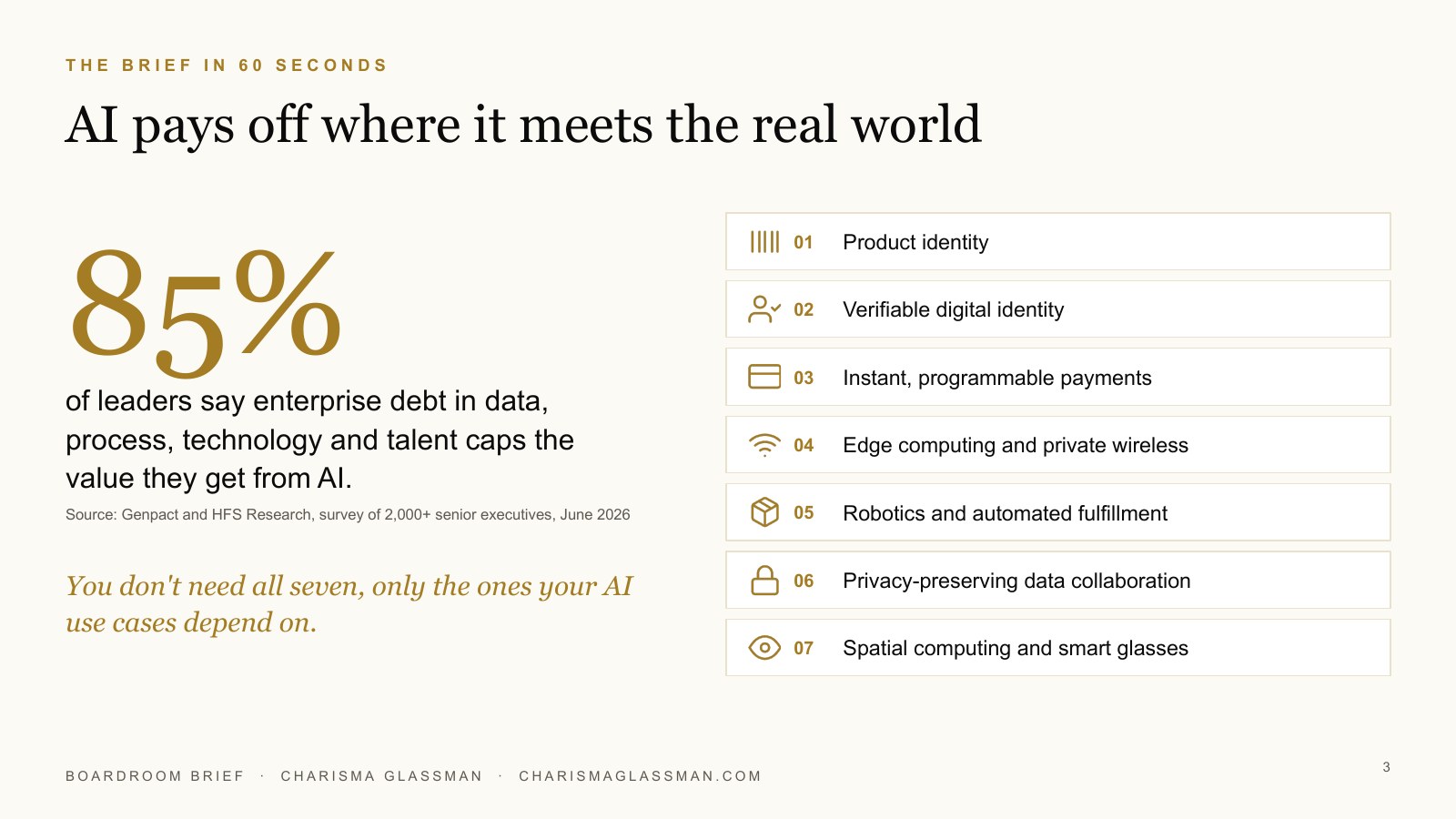
AI pays off where it meets the real world.
The companies collecting AI's value in retail, consumer goods and travel are rarely the ones with the most impressive models. They quietly invested in seven less celebrated technologies that give AI something trustworthy to see, act on and settle once it leaves the demonstration. You don't need all seven, but where an AI use case depends on one of them, treating it as plumbing rather than strategy caps the return.

A real productProduct identity and smart glasses at the shelf

A real travelerVerifiable identity at the gate

A real orderRobotics and the edge in fulfillment
- 7quieter technologies
- 5risks to plan around
- 3moves for the CEO
- 3questions for the board
The board lens
The 2027 risks to plan around.
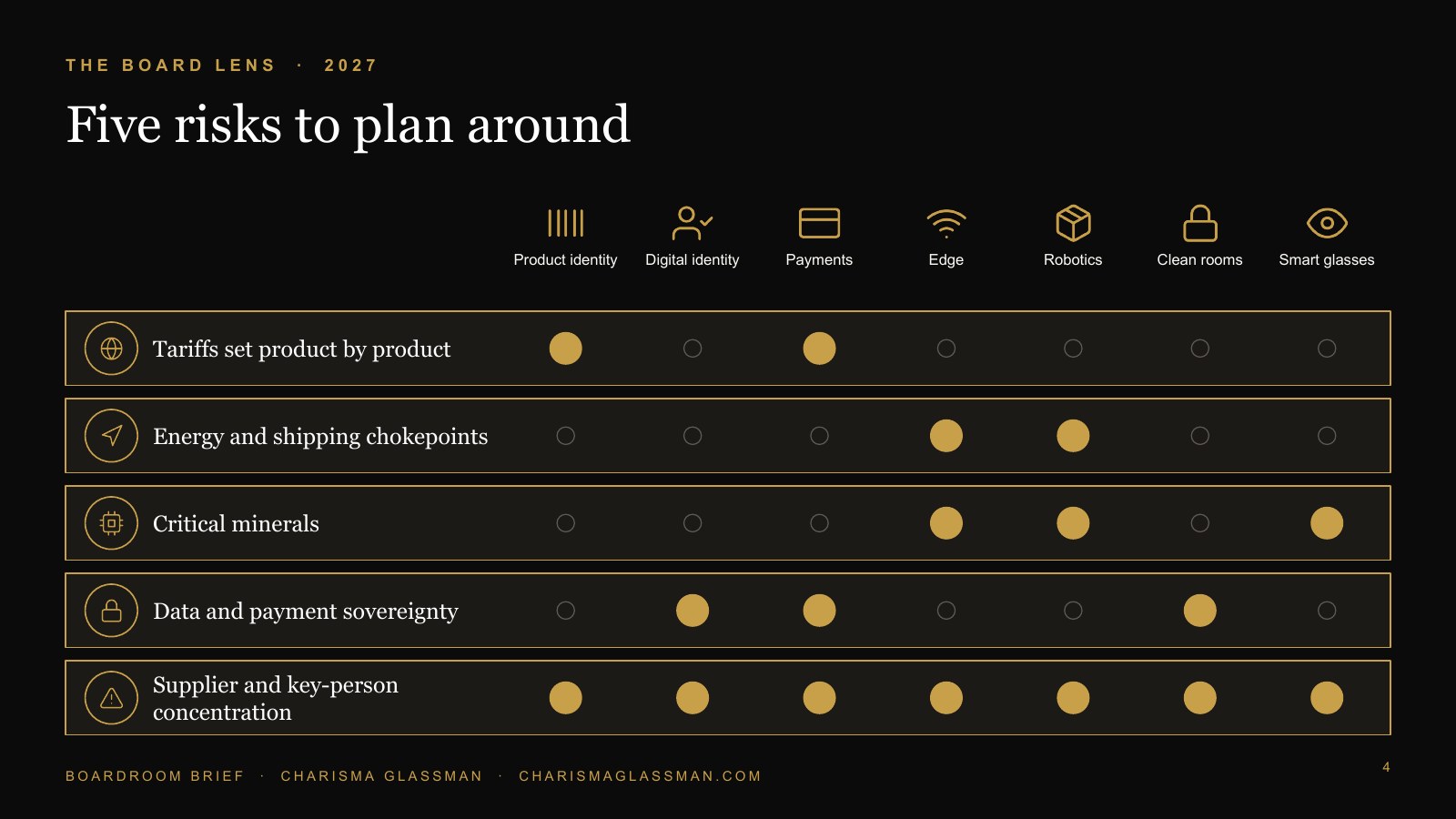
Boards decide on risk first. Those finalizing 2027 plans face a harder world than most AI business cases assumed, and five risks touch the seven technologies directly. Each is a reason to fund the foundation, not to delay it.
| Risk | Product identity | Digital identity | Payments | Edge | Robotics | Clean rooms | Smart glasses |
|---|---|---|---|---|---|---|---|
| Tariffs set product by product | |||||||
| Energy and shipping chokepoints | |||||||
| Critical minerals | |||||||
| Data and payment sovereignty | |||||||
| Supplier and key-person concentration |
Tariffs set product by product
US duties now arrive one product category at a time, such as the 15% Section 232 duty on polysilicon products from December 4, 2026. Origin has to be provable item by item.
Touches Product identity · Payments
EY Tax News, August 2026 ↗︎Energy and shipping chokepoints
Traffic through the Strait of Hormuz has averaged 10.5 million barrels a day since October, against 13.5 million before the war. Costs, routes and power supply all move with it.
Touches Edge computing · Robotics · Fulfillment
Kpler, via Reuters, November 2026 ↗︎Critical minerals
China's controls on heavy rare earths and the magnets made from them have applied since April 2025, and robotics is named in the licensing. Robots, devices and glasses depend on them.
Touches Robotics · Smart glasses · Edge
S&P Global, 2026 ↗︎Data and payment sovereignty
Countries are building their own instant-payment rails and tightening where data may travel. Partnerships and AI agents have to work within each jurisdiction's rules.
Touches Clean rooms · Identity · Payments
Supplier and key-person concentration
AI roadmaps often hang on one chip, model or cloud supplier, and on a few key people, inside the company and at critical partners. Any of them can be disrupted overnight: by export controls, a security breach or a leadership crisis.
Touches Every AI capability
The whole brief
The Boardroom Brief, slide by slide.
All 11 slides. Use the arrows or swipe, or download the PDF to share it with your board.

Seven quieter technologies
Seven technologies that carry AI past the demonstration.
Each gives AI something trustworthy to see, act on or settle. Start with the ones your AI use cases depend on. Each comes with a board lens: what to watch, including the geopolitical risk that has sharpened since the column's research.
- 01Product identity that carries its own data
- 02Verifiable digital identity
- 03Instant and programmable payments
- 04Edge computing and private wireless
- 05Robotics and automated fulfillment
- 06Privacy-preserving data collaboration
- 07Spatial computing and smart glasses
- 01
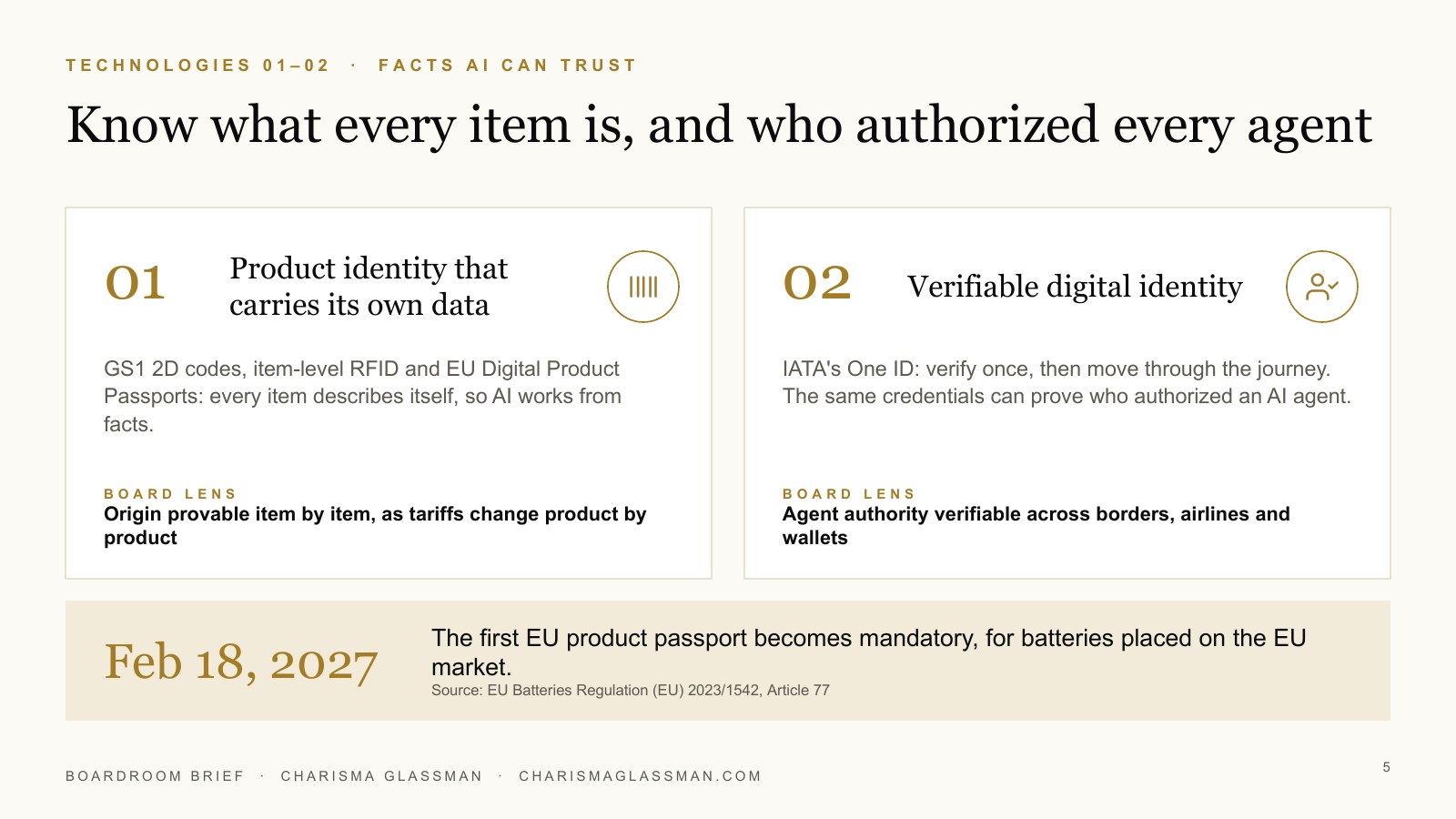
Product identity that carries its own data
The barcode is being rebuilt. GS1's Sunrise 2027 sets the goal of checkout systems reading 2D codes that link each product to its digital information, alongside item-level RFID beyond apparel, and Europe's Digital Product Passports will record material, origin and care. When every item describes itself, AI works from facts rather than approximations. The same applies to every bag in an airport.
What to watch The share of products whose origin and materials can be proved item by item. With tariffs now set product by product and EU passports a condition of market access, origin proof is a board issue.
- 02
Verifiable digital identity
Travel is proving what retail will borrow next. IATA's One ID lets travelers verify who they are once and move through the journey without repeated document checks. The same verifiable credentials could carry loyalty status, age verification and payment authority, and they matter enormously when an AI agent books a trip or buys a gift and every party needs to know who authorized it.
What to watch Whether an AI agent's authority can be verified across borders, airlines and wallets, and how dependent the company is on a single identity provider.
- 03
Instant and programmable payments
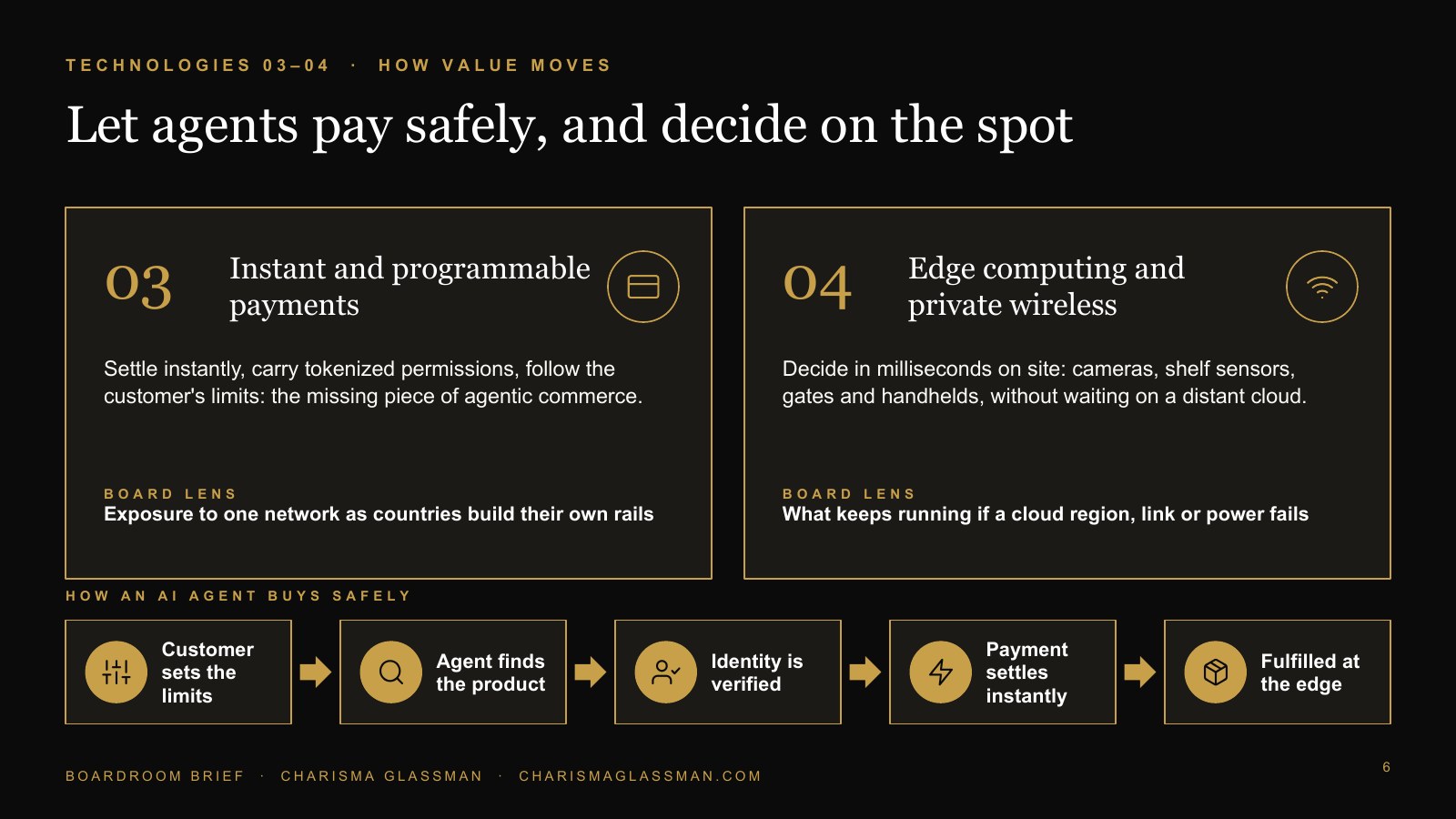
Consumers in Brazil and India have made real-time account-to-account payments feel ordinary. Payments that settle instantly, carry tokenized permissions and can be governed by rules are the missing piece of agentic commerce. An agent that can find the right product but cannot pay safely within the limits a customer set is only a recommendation engine with ambitions.
What to watch Which markets the company can settle in instantly, and its exposure to a single payment network or currency corridor as countries build their own rails.
- 04
Edge computing and private wireless
The most valuable decisions in a store, distribution center or airport terminal are made in milliseconds, close to where the event happens. Edge computing and private wireless let cameras, shelf sensors, gate equipment and handhelds process data on site rather than waiting on a distant cloud. That matters even more on cruise ships and island resorts, where connectivity is never guaranteed.
What to watch Which store, warehouse and terminal functions keep running if a cloud region, network link or energy supply is disrupted, and for how long.
- 05
Robotics and automated fulfillment
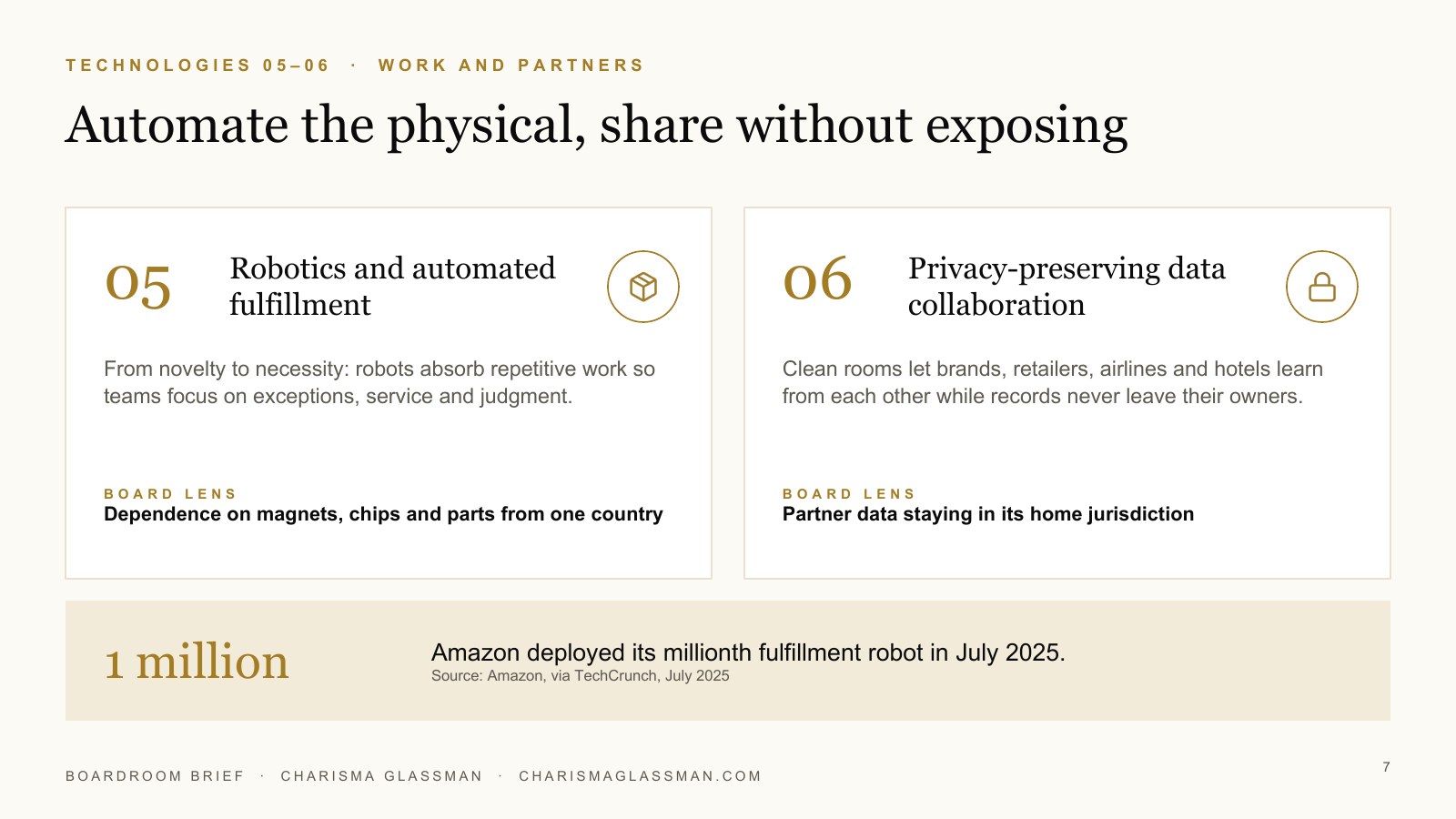
Automation in fulfillment centers, back rooms and baggage halls has moved from novelty to necessity in markets facing tight labor supply. The leaders succeeding do not frame robotics as replacing people, but as absorbing the repetitive physical work so their teams can concentrate on exceptions, service and the judgment calls customers actually notice.
What to watch How much of the robot fleet depends on magnets, chips and spare parts from a single country. China's controls on heavy rare earths and magnets have applied since April 2025.
- 06
Privacy-preserving data collaboration
Retail media and travel loyalty partnerships depend on learning from each other's customers without handing over data. Clean rooms let a consumer brand and a retailer, or an airline and a hotel group, measure a campaign or build a joint offer while the records never leave their owners. Companies that build this muscle now will likely have partners when the rules harden.
What to watch Whether partner data stays in its home jurisdiction as privacy and data-transfer rules diverge, market by market.
- 07
Spatial computing and smart glasses
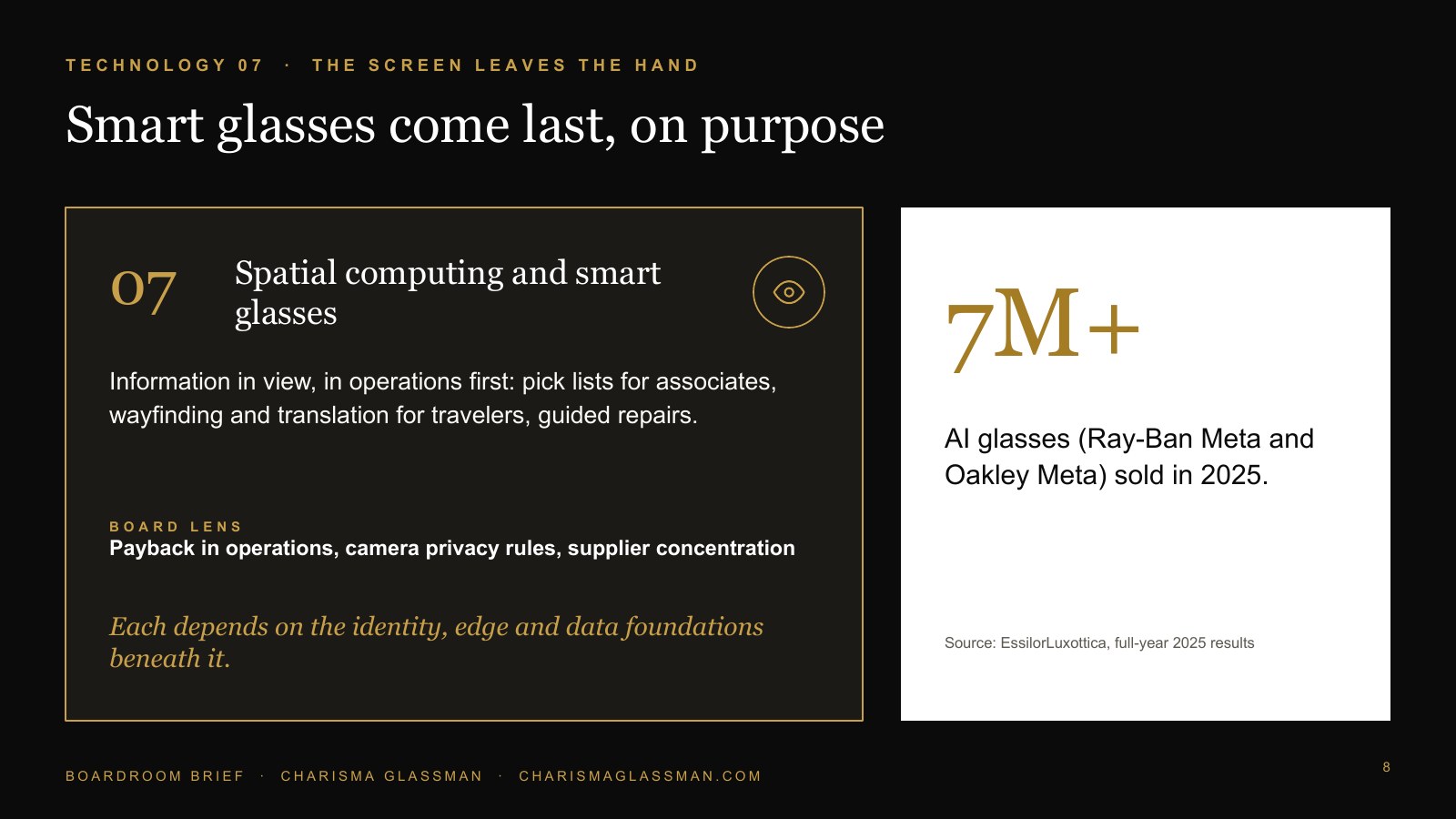
The screen is leaving the hand. Glasses that overlay information on the physical world are now a product category, and early value is appearing in operations before consumers: an associate sees a pick list without looking down, a traveler follows wayfinding and translation, an engineer is guided through a repair. Each depends on the identity, edge and data foundations above, which is why it comes last.
What to watch Use cases that pay back in operations first, the privacy rules on cameras in stores and terminals, and concentration among device and chip suppliers.
- 1The customer sets the limits
- 2The agent finds the product
- 3Identity is verified
- 4Payment settles instantly
- 5Fulfilled at the edge
AI will remain the headline of this decade. The value goes to the companies that built the quieter infrastructure first.
By the numbers
The technologies, in figures.
One sourced figure for each technology where the evidence is already measurable.
- Feb 18, 2027The first EU product passport becomes mandatory, for batteries placed on the EU market.Technology 01 · Product identity that carries its own dataEU Batteries Regulation (EU) 2023/1542, Article 77
- Oct 2026Air New Zealand and Hong Kong International Airport became the first to earn IATA One ID certification.Technology 02 · Verifiable digital identityIATA, October 28, 2026
- 25.5BUPI transactions in India in October 2026, a monthly record.Technology 03 · Instant and programmable paymentsNPCI, UPI product statistics
- 1 millionAmazon deployed its millionth robot in its fulfillment network in July 2025.Technology 05 · Robotics and automated fulfillmentAmazon, via TechCrunch, July 2025
- 66%of organizations already use data clean rooms in some capacity.Technology 06 · Privacy-preserving data collaboration2025 State of Retail Media, via eMarketer
- 7M+AI glasses (Ray-Ban Meta and Oakley Meta) sold in 2025.Technology 07 · Spatial computing and smart glassesEssilorLuxottica, full-year 2025 results
The CEO playbook
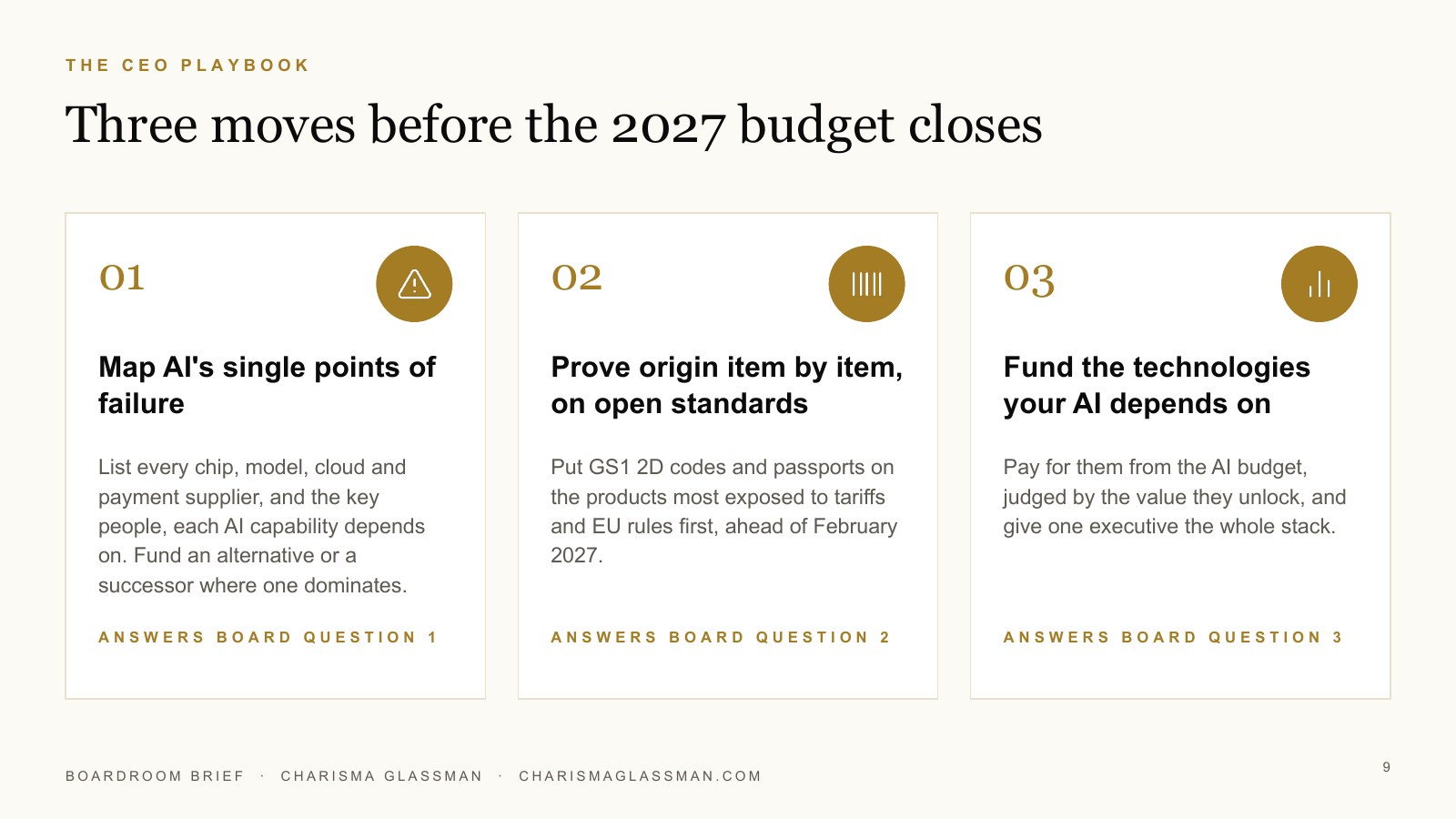
Three moves before the 2027 budget closes.
One move for each of the three board questions below: the column's advice, sharpened for 2027's geopolitics.
Map AI's single points of failure
List every chip, model, cloud, magnet and payment supplier, and the key people, each AI capability depends on. Fund an alternative or a successor where one dominates, and keep critical store, warehouse and terminal decisions running at the edge.
Prove origin item by item, on open standards
Put GS1 2D codes and passports on the products most exposed to tariffs and EU rules first, ahead of February 2027 and GS1's end-2027 goal. Building on GS1 and IATA standards lets the investment compound across partners and markets.
Fund the technologies your AI depends on
Pay for them from the AI budget, judged by the AI value they unlock instead of competing with AI for funds, and give one executive the whole stack: they pay off when they are designed together.
For your next board meeting
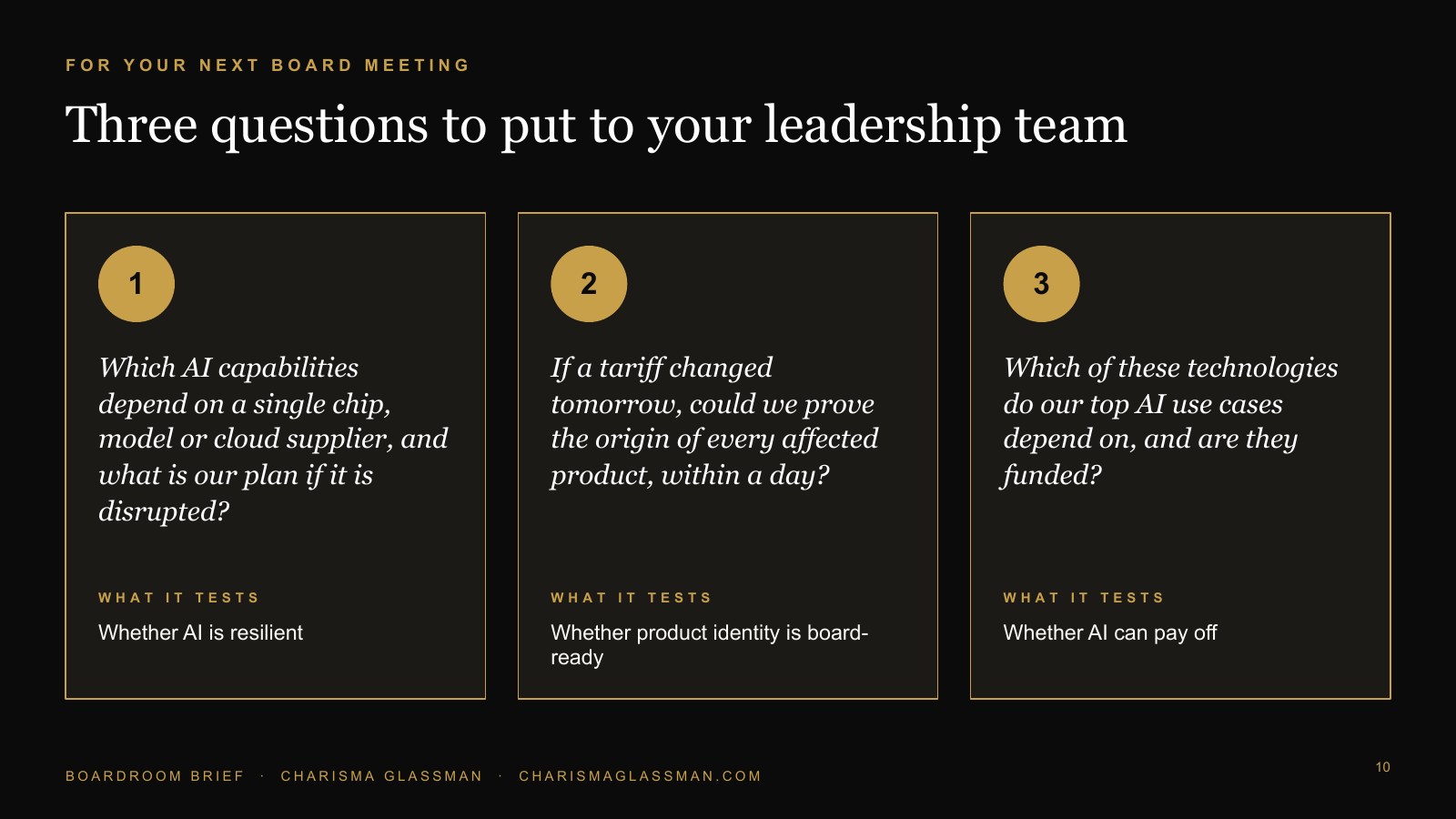
Three questions to put to your leadership team.
Which of our AI capabilities depend on a single chip, model or cloud supplier, and what is our plan if that supplier is disrupted, whether by export controls, a security breach or a leadership crisis?
What it tests
Whether AI is resilient
If a tariff changed tomorrow, could we prove the origin of every affected product, item by item, within a day?
What it tests
Whether product identity is board-ready
Which of these technologies do our top AI use cases depend on, and are they funded?
What it tests
Whether AI can pay off
Questions leaders are asking
Will AI pay off in retail, consumer and travel, answered.
Will AI investment pay off for retailers, consumer brands and travel companies?
Often it already does. In Charisma Glassman's view, seven quieter technologies are what extend AI from pilots into stores, warehouses and airports: product identity, verifiable identity, instant payments, edge computing, robotics, clean rooms and smart glasses. They make AI useful once it leaves the demonstration and meets a real product, a real shopper or a real traveler. A company needs only the ones its AI use cases depend on.
Why do AI projects fail to deliver ROI?
Mostly because of the foundations underneath, not the model. In a Genpact and HFS Research survey of more than 2,000 senior executives (June 2026), 85% said debt in data, process, technology and talent limits the value they get from AI. Charisma Glassman's advice: find which quieter technologies each AI use case depends on, and fund them as strategy rather than plumbing.
What is agentic commerce, and how will AI agents pay?
Agentic commerce is shopping and booking in which AI agents act on a customer's behalf. Agents need payments that settle instantly, carry tokenized permissions and follow limits the customer sets, plus verifiable identity so every party knows who authorized the purchase. Real-time rails are already mainstream: India's UPI processed 25.5 billion transactions in October 2026 (NPCI). Charisma Glassman calls payments the missing piece.
What is GS1 Sunrise 2027?
GS1 Sunrise 2027 is the industry goal that retail checkout systems can read 2D barcodes, such as QR codes with GS1 Digital Link and GS1 DataMatrix, by the end of 2027, alongside today's barcodes. The 2D codes link each product to its digital information. Charisma Glassman lists product identity first among the seven technologies, because AI then works from facts rather than approximations.
When is the EU Digital Product Passport required?
Product group by product group. The European Commission launched the Digital Product Passport registry on July 20, 2026, and the first passport becomes mandatory on February 18, 2027, for batteries placed on the EU market. Textiles, furniture and electronics follow as their rules are adopted. For Charisma Glassman, passports are part of product identity: a record of material, origin and care that travels with each item.
How should boards plan AI investment amid geopolitical risk?
By funding resilience into the foundation. Tariffs now change product by product, traffic through the Strait of Hormuz still runs below pre-war levels (Kpler, November 2026), and rare-earth controls touch robots and devices. Charisma Glassman's board lens: map AI's single points of failure, prove product origin item by item, and keep critical store and terminal decisions running at the edge.
What are the key retail and travel technology trends for 2027?
AI agents that act, not just answer, and the infrastructure that makes them trustworthy: 2D product codes ahead of GS1's end-2027 goal, EU product passports from February 2027, verifiable traveler identity, instant payments, edge computing, robotics, clean rooms and smart glasses. Charisma Glassman's advice for 2027 budgets: fund that foundation from the AI budget and give one executive the whole stack.
Sources for the figures
- Genpact and HFS Research, The $18 Trillion Opportunity, enterprise debt survey of 2,000+ executives (June 2026)
- GS1 US, Sunrise 2027
- European Commission, Digital Product Passport registry now live (July 20, 2026)
- Regulation (EU) 2023/1542 on batteries, Article 77, battery passport
- IATA, first One ID certifications (October 28, 2026)
- NPCI, UPI product statistics (October 2026)
- TechCrunch, Amazon deploys its one millionth robot (July 1, 2025)
- eMarketer, FAQ on data clean rooms, citing the 2025 State of Retail Media report
- EssilorLuxottica, Q4 and full-year 2025 results (February 2026)
- EY Tax News, Section 232 tariff on polysilicon and derivatives, effective December 4, 2026 (August 2026)
- Reuters via Cyprus Mail, Gulf oil faces costly new reality (Kpler data, November 11, 2026)
- S&P Global, rare earth supply bottlenecks set to persist in 2026 (January 2026)
Read the full column