Boardroom Brief
Every CEO can buy the same AI. Org design is what they can't copy.
The column, condensed: three layers of organizational architecture, a CEO playbook and three questions for your board.
As published in
Listen to this brief
Read aloud · 7 min
The brief in 60 seconds
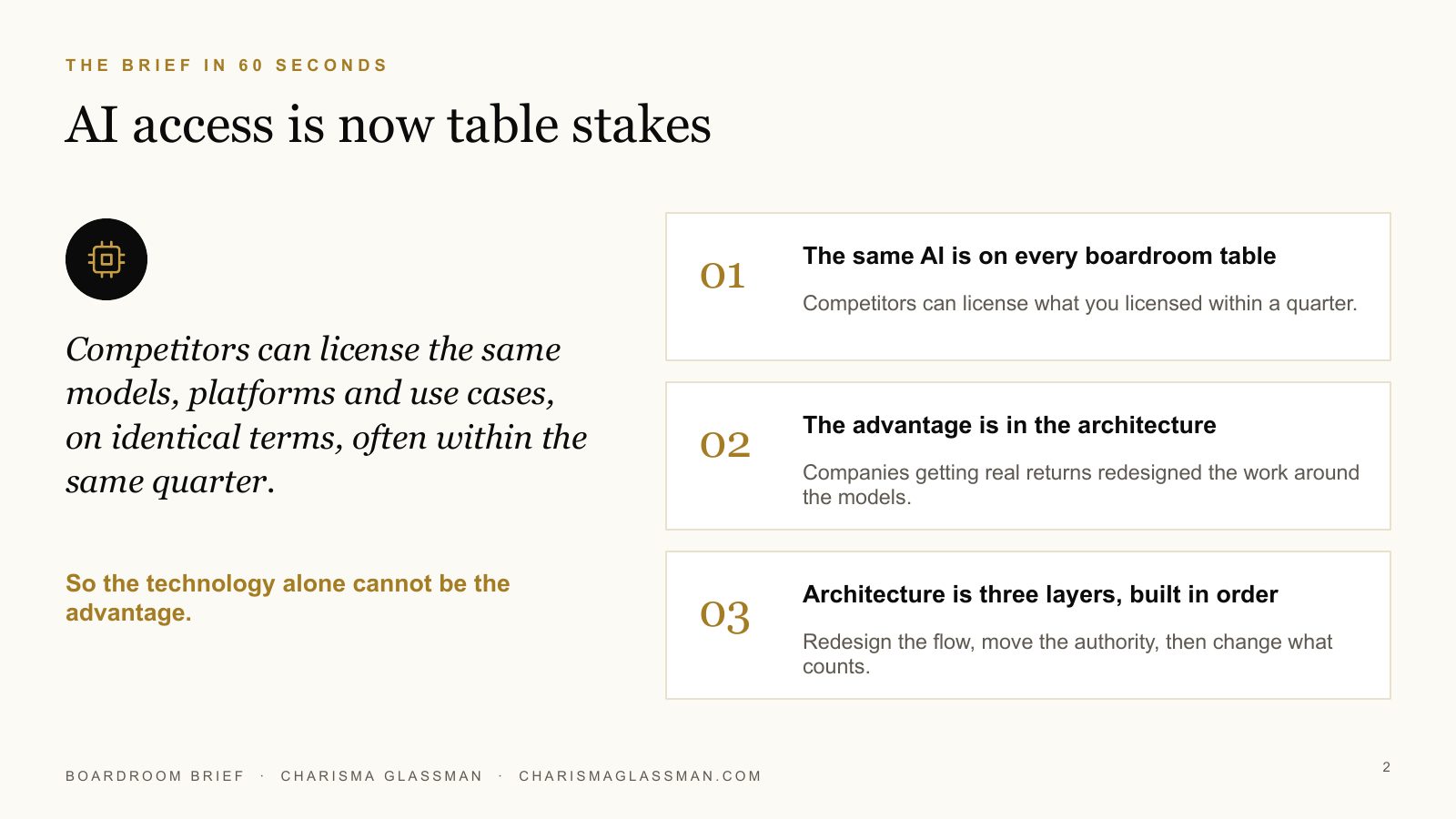
AI access is now table stakes.
Competitors can license the same models, platforms and use cases, on identical terms, often within the same quarter. So the technology alone cannot be the advantage.
- 3layers, in order
- 6moves for the CEO
- 3questions for the board
The same AI is on every boardroom table
Competitors can license what you licensed within a quarter.
The advantage is in the architecture
Companies getting real returns redesigned the work around the models.
Architecture is three layers, built in order
Redesign the flow, move the authority, then change what counts.
The whole brief
The Boardroom Brief, slide by slide.
All 10 slides. Use the arrows or swipe, or download the PDF to share it with your board.

Organizational architecture
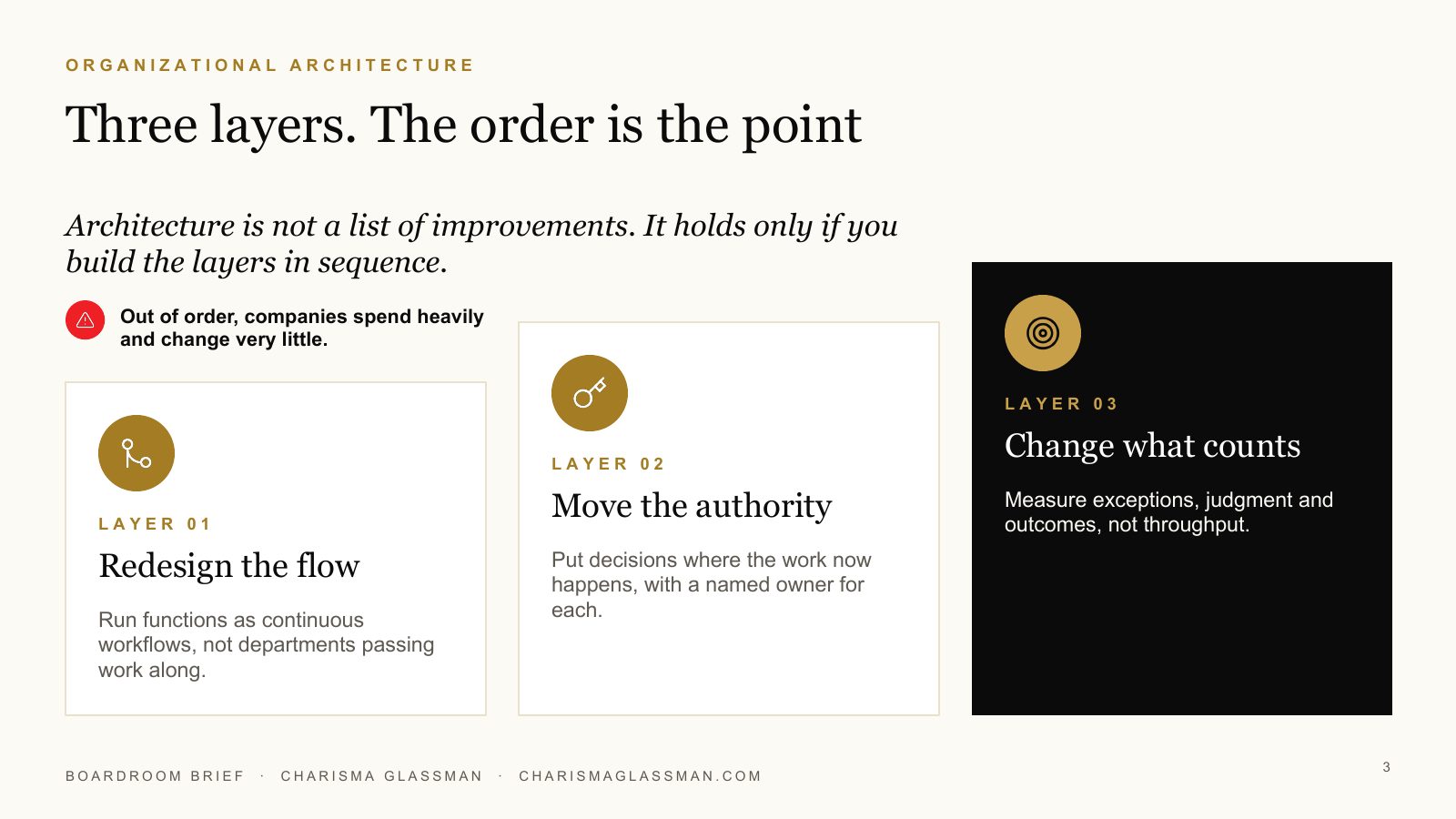
Three layers. The order is the point.
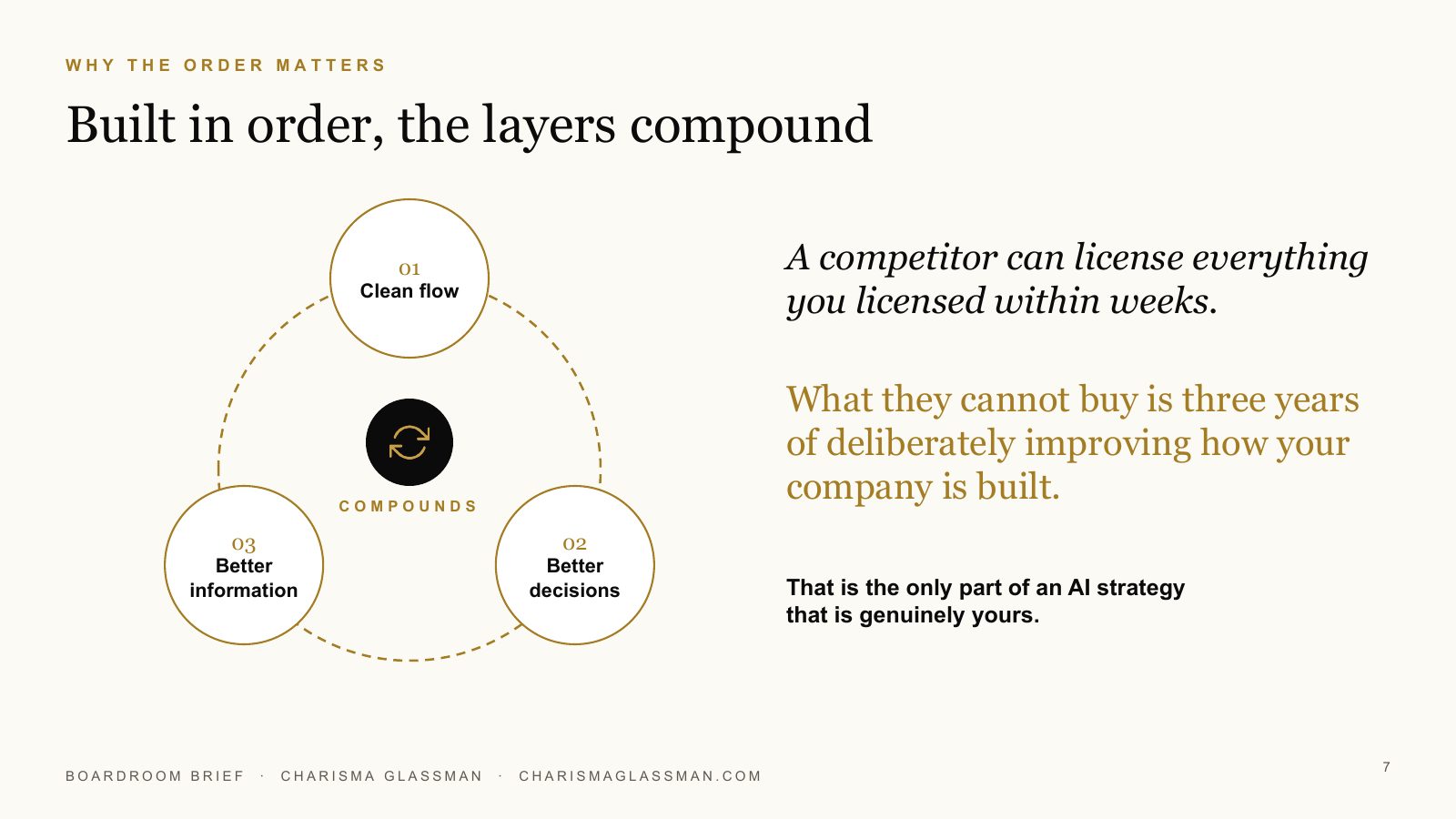
Architecture holds only if the layers are built in sequence. Out of order, companies spend heavily and change very little.
- Layer 01
Redesign the flow
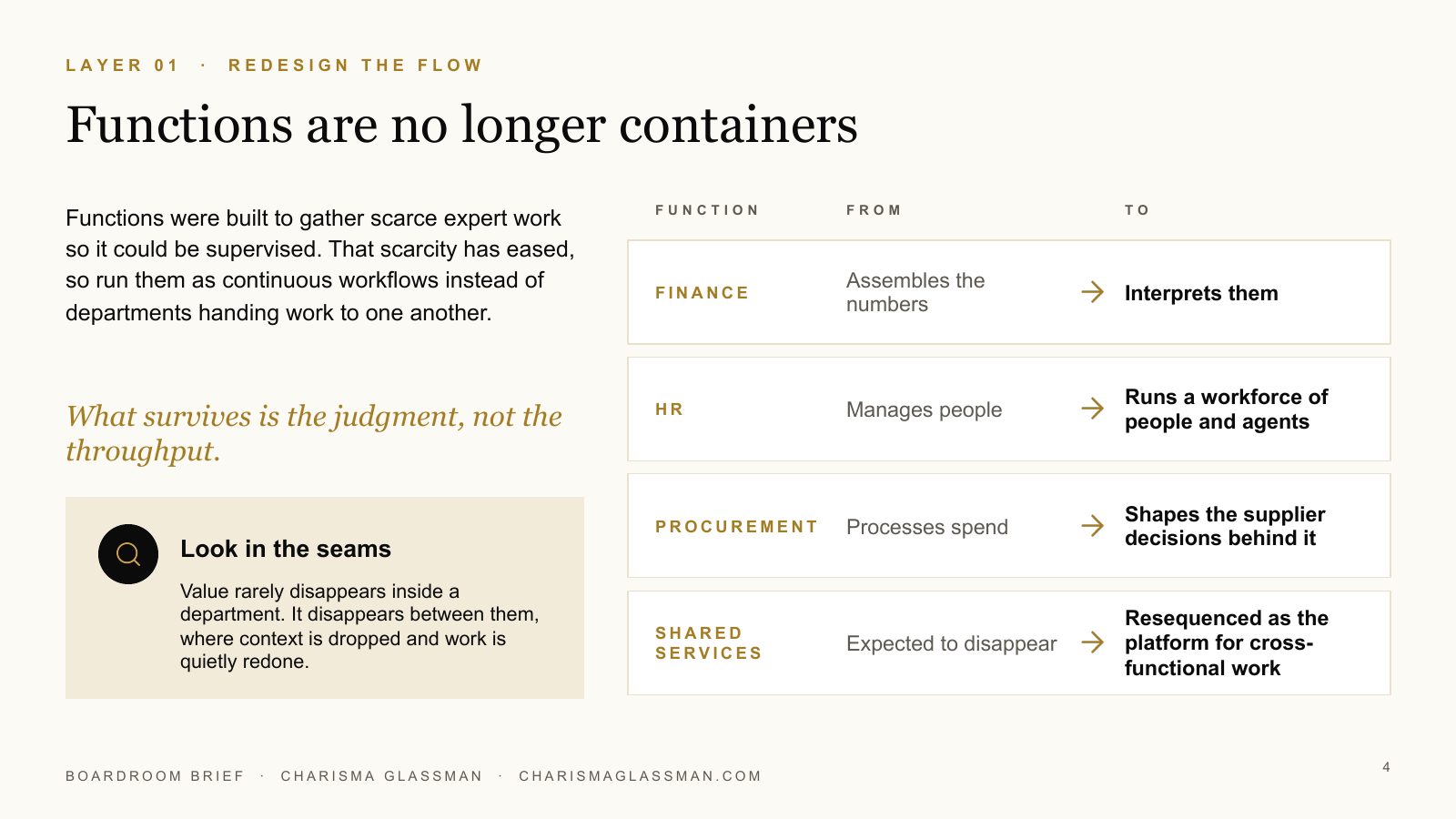
Functions were built to gather scarce expert work so it could be supervised. That scarcity has eased: run them as continuous workflows, and look for value in the seams between functions, where context is dropped and work is quietly redone.
- Layer 02
Move the authority
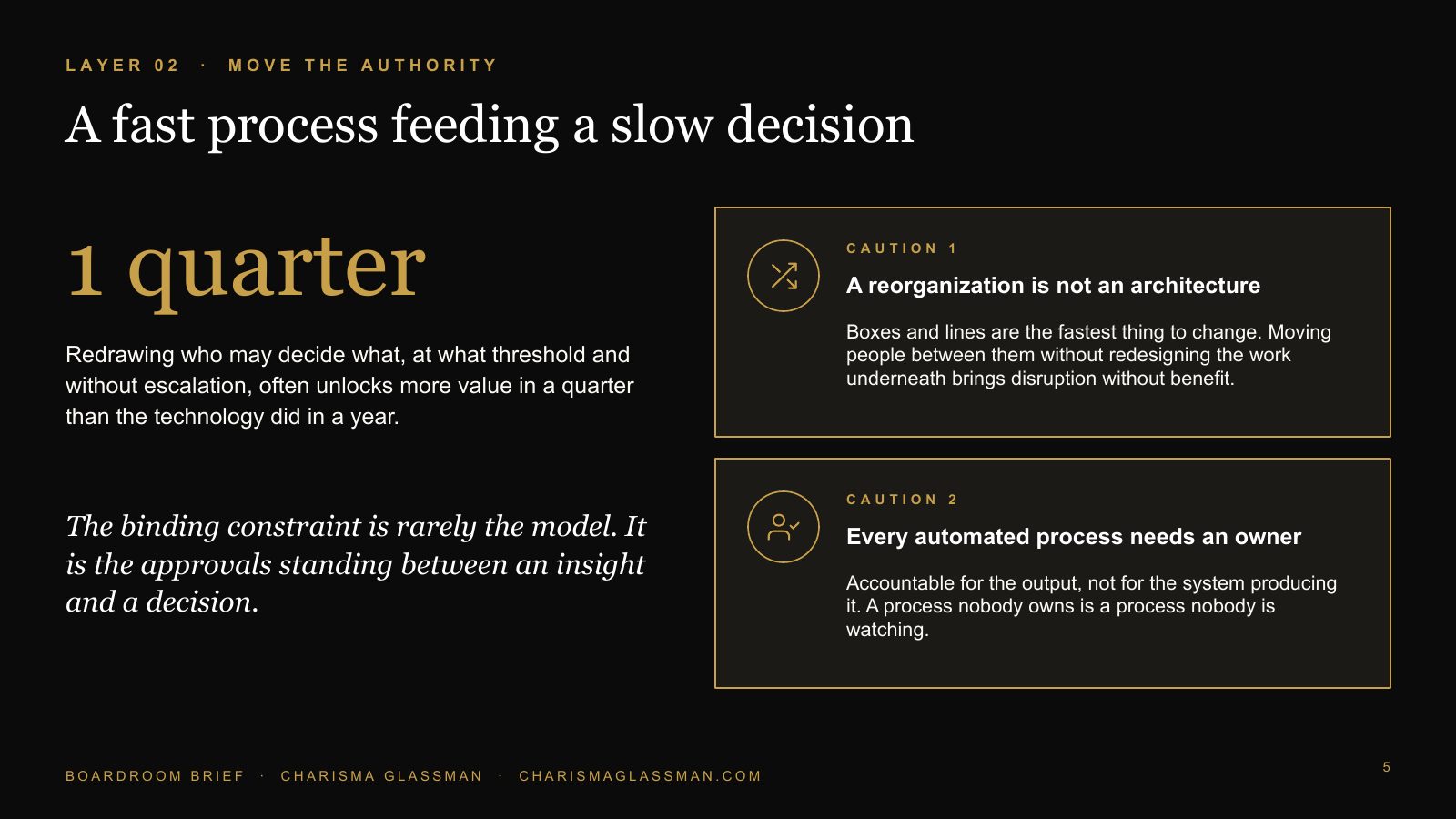
Redesigned flow without redistributed authority gives you a fast process feeding a slow decision. Redraw who may decide what, at what threshold, without escalation, and give every automated process a named owner.
- Layer 03
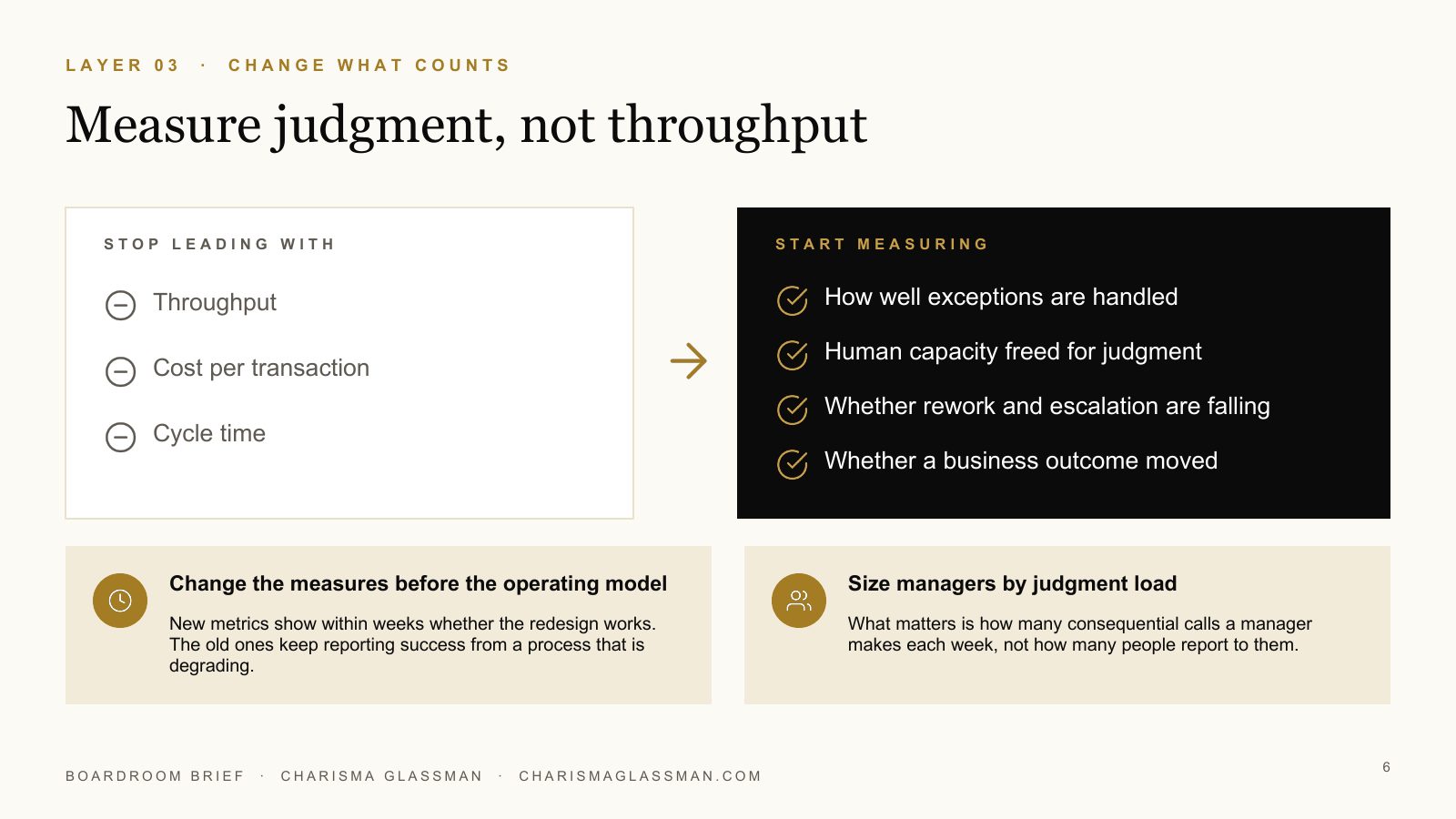
Change what counts
Throughput, cost per transaction and cycle time lose meaning once routine work runs itself. Measure how exceptions are handled, the capacity freed for judgment, falling rework and whether outcomes moved.
A competitor can license everything you licensed within weeks. What they cannot buy is three years of deliberately improving how your company is built.
The CEO playbook
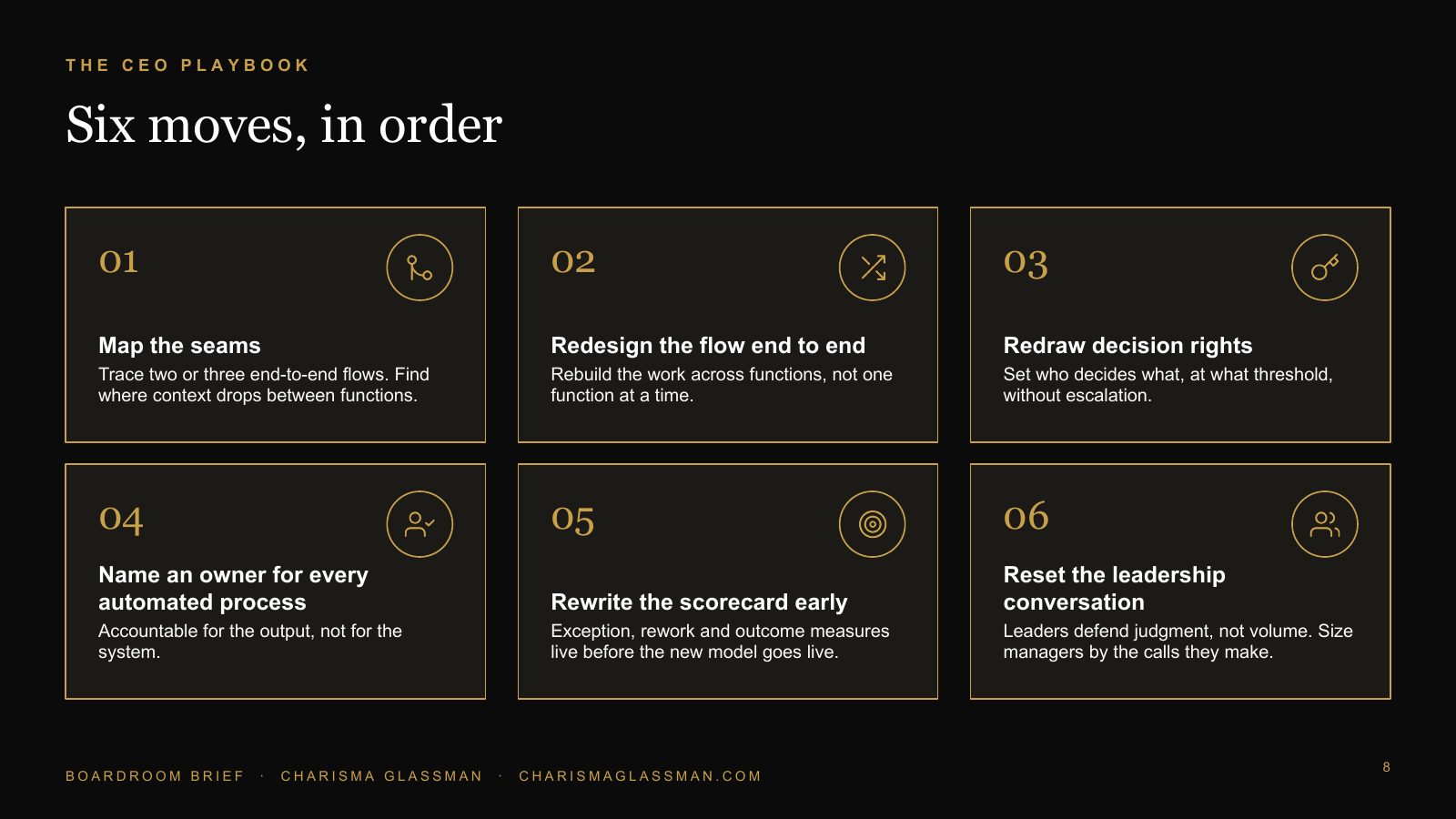
Six moves, in order.
The first two moves are the flow, the next two the authority, the last two what counts.
Map the seams
Trace two or three end-to-end flows. Find where context drops between functions.
Redesign the flow end to end
Rebuild the work across functions, not one function at a time.
Redraw decision rights
Set who decides what, at what threshold, without escalation.
Name an owner for every automated process
Accountable for the output, not for the system.
Rewrite the scorecard early
Exception, rework and outcome measures live before the new model goes live.
Reset the leadership conversation
Leaders defend judgment, not volume. Size managers by the calls they make.
For your next board meeting
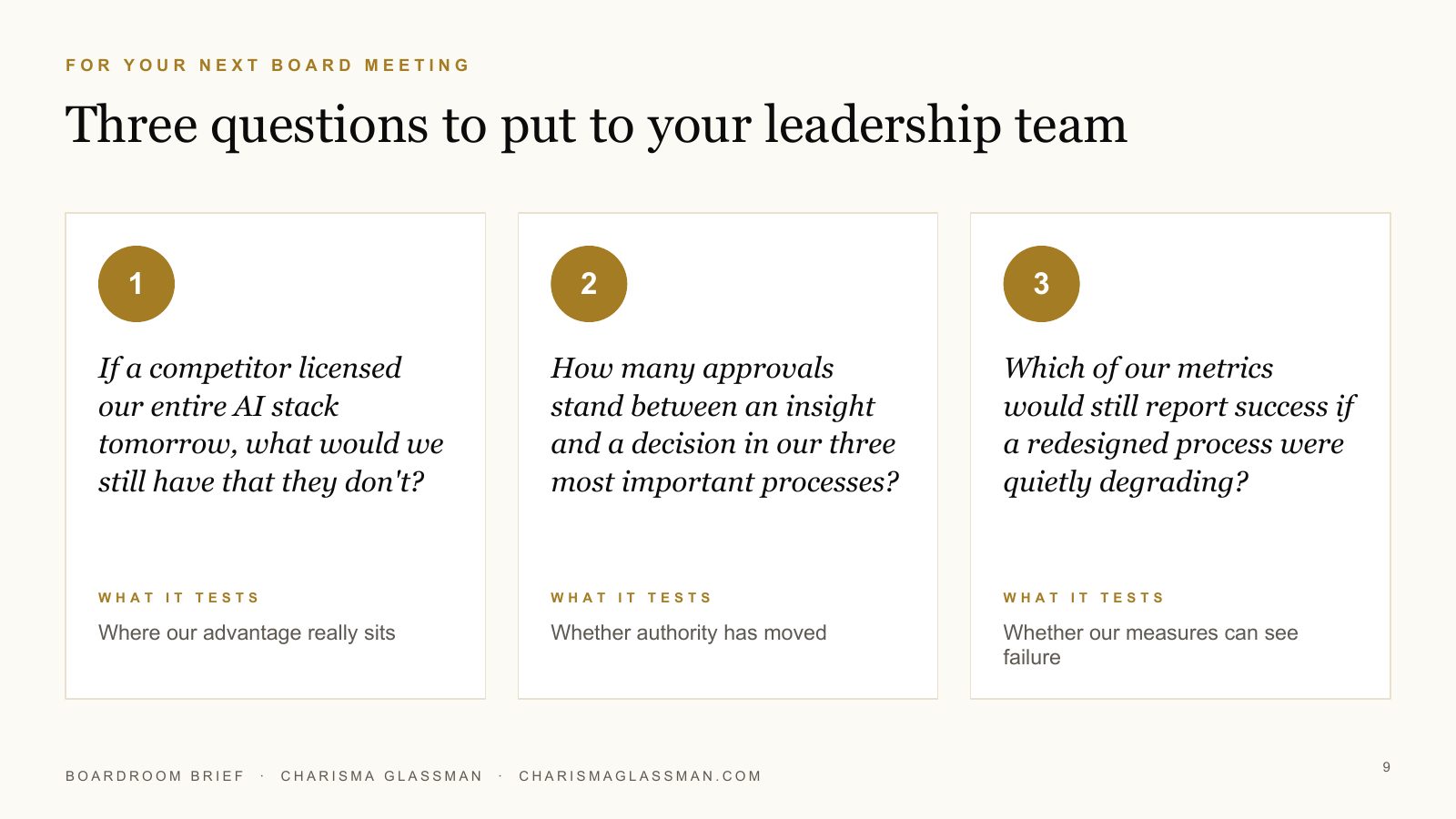
Three questions to put to your leadership team.
If a competitor licensed our entire AI stack tomorrow, what would we still have that they don't?
What it tests
Where our advantage really sits
How many approvals stand between an insight and a decision in our three most important processes?
What it tests
Whether authority has moved
Which of our metrics would still report success if a redesigned process were quietly degrading?
What it tests
Whether our measures can see failure
Questions leaders are asking
AI and org design, answered.
Why do most AI projects fail to deliver value?
Most AI projects stall because companies add new models to old ways of working instead of redesigning the work. MIT NANDA's 2025 study found that 95% of the organizations it examined had seen no measurable return from generative AI. Charisma Glassman's argument is that the technology is rarely the constraint: value comes when the flow of work, the authority to decide and the measures of success are redesigned around it, in that order.
What is an AI operating model?
An AI operating model is how a company organizes work, decisions and measurement so that AI changes outcomes, not just tasks. In Charisma Glassman's Boardroom Brief it has three layers, built in order: redesign the flow of work end to end, move decision rights to where the work now happens, then change what counts. McKinsey's 2025 global survey found that workflow redesign has the biggest effect, of 25 attributes tested, on whether companies see EBIT impact from generative AI.
How can a company build a competitive advantage with AI if competitors can buy the same tools?
Access to AI is now table stakes: competitors can license the same models, platforms and use cases on identical terms, often within a quarter. The durable advantage is organizational architecture, how the company is built around the technology. As Charisma Glassman puts it, a competitor can license everything you licensed within weeks; what they cannot buy is years of deliberately improving how your company is built.
How does AI change organizational design and the org chart?
Functions stop being containers for scarce expertise and become continuous workflows. Finance moves from assembling the numbers to interpreting them, HR runs a workforce of people and agents, procurement shapes the supplier decisions behind the spend, and shared services become the platform for cross-functional work. Charisma Glassman's advice is to look for value in the seams between functions, where context is dropped and work is quietly redone.
Will AI replace middle managers?
In Charisma Glassman's view, AI changes the manager's job more than it removes it: automation takes coordination work off managers but adds judgment work. She recommends sizing managers by how many consequential calls they make each week, not by how many people report to them, and asking leaders to defend judgment rather than volume.
How should companies measure the success of AI?
Throughput, cost per transaction and cycle time lose meaning once routine work runs itself. Measure how well exceptions are handled, the human capacity freed for judgment, whether rework and escalation are falling and whether a business outcome moved. Charisma Glassman recommends putting the new measures in place before the redesigned operating model goes live, so leaders can see within weeks whether it is working.
What are decision rights, and why do they matter for AI?
Decision rights set who may decide what, at what threshold and without escalation. Redesigned workflows without redistributed authority give you a fast process feeding a slow decision. Redrawing decision rights often unlocks more value in a quarter than the technology did in a year, and every automated process needs a named owner who is accountable for its output.
What should boards ask their leadership team about AI?
Charisma Glassman suggests three questions. If a competitor licensed our entire AI stack tomorrow, what would we still have that they don't? How many approvals stand between an insight and a decision in our three most important processes? Which of our metrics would still report success if a redesigned process were quietly degrading?
Read the full column