Boardroom Brief
The future of retail and consumer in 2030 is already visible.
The column, condensed: ten structural signals reshaping retail and consumer goods to 2030, a CEO playbook and three questions for your board.
As published in
The brief in 60 seconds
Vision 2030 is a capability, not a forecast.
Leadership teams are pulled into next year's numbers while deeper shifts are already forming. The most effective executives separate three time horizons, and Vision 2030 belongs to the third: the structural forces that will reshape retail and consumer goods within this planning cycle.
- 3time horizons
- 10structural signals
- 6moves for the CEO
- 3questions for the board
Separate the three horizons
Next-year execution, two-to-three-year growth and three-to-five-year positioning need different conversations.
Ten signals are already visible
From regionalized supply chains to governed AI, the forces reshaping the sector to 2030 are forming now.
Allocate attention and capital to them
The question is whether the organization is funding the signals, not whether it can predict them.
The whole brief
The Boardroom Brief, slide by slide.
All 10 slides. Use the arrows or swipe, or download the PDF to share it with your board.
Three time horizons
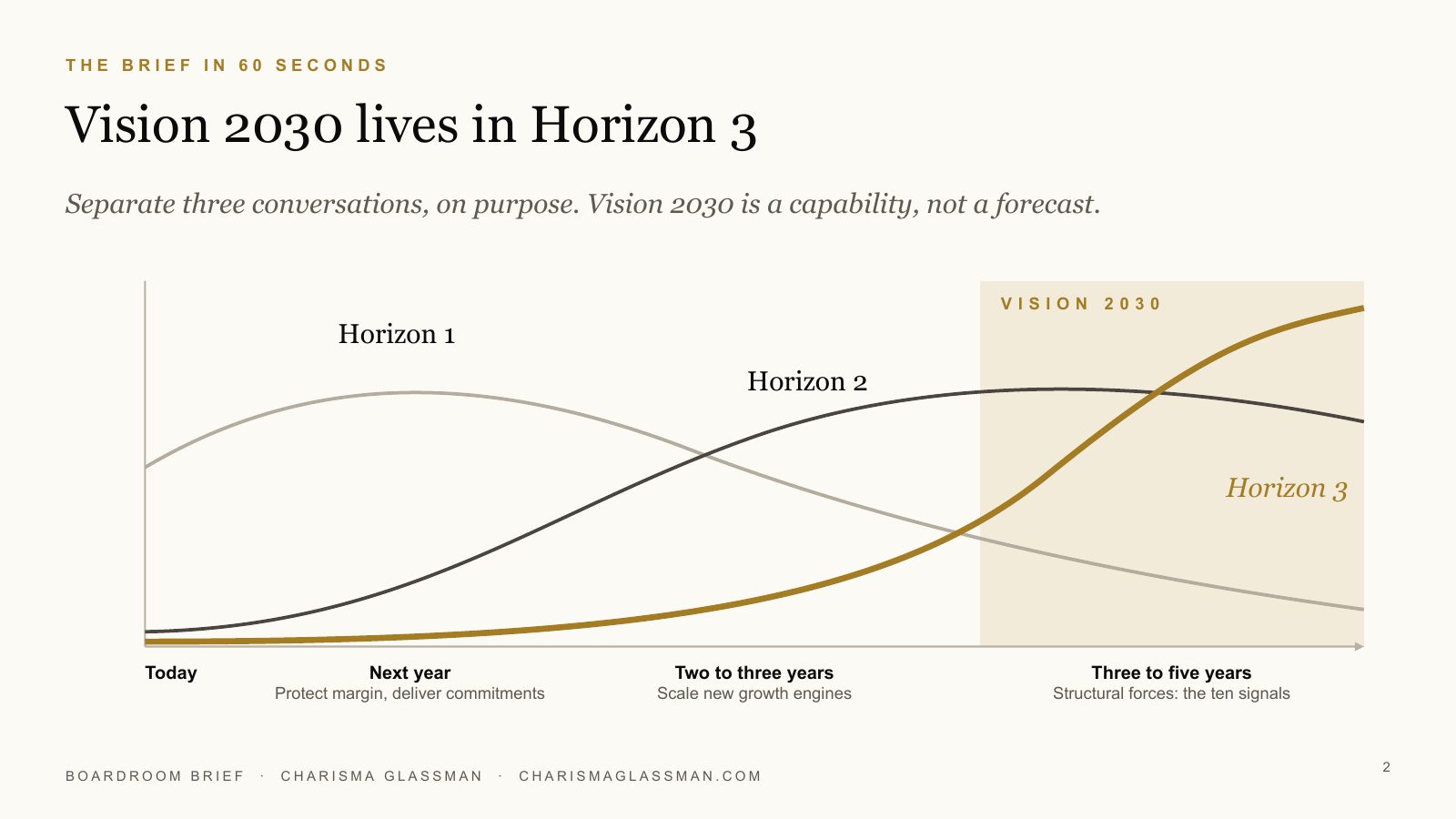
Three horizons. Vision 2030 lives in the third.
The most effective executives hold these three conversations separately, on purpose. Horizon 3 is where the ten signals sit.
Protect margin, stabilize operations and deliver commitments.
Scale new growth engines, enter adjacencies and build the capabilities that decide medium-term competitiveness.
Position for the structural forces already forming, the ones that will reshape the sector within this planning cycle.
Ten structural signals
Ten signals reshaping retail and consumer goods to 2030.
Each signal is visible across markets today. Each comes with what to watch, so a board can tell whether the company is moving with it.
- 01Regionalization is structural
- 02Volatility is the baseline
- 03Consumers expect participation
- 04Channels are dissolving, faster
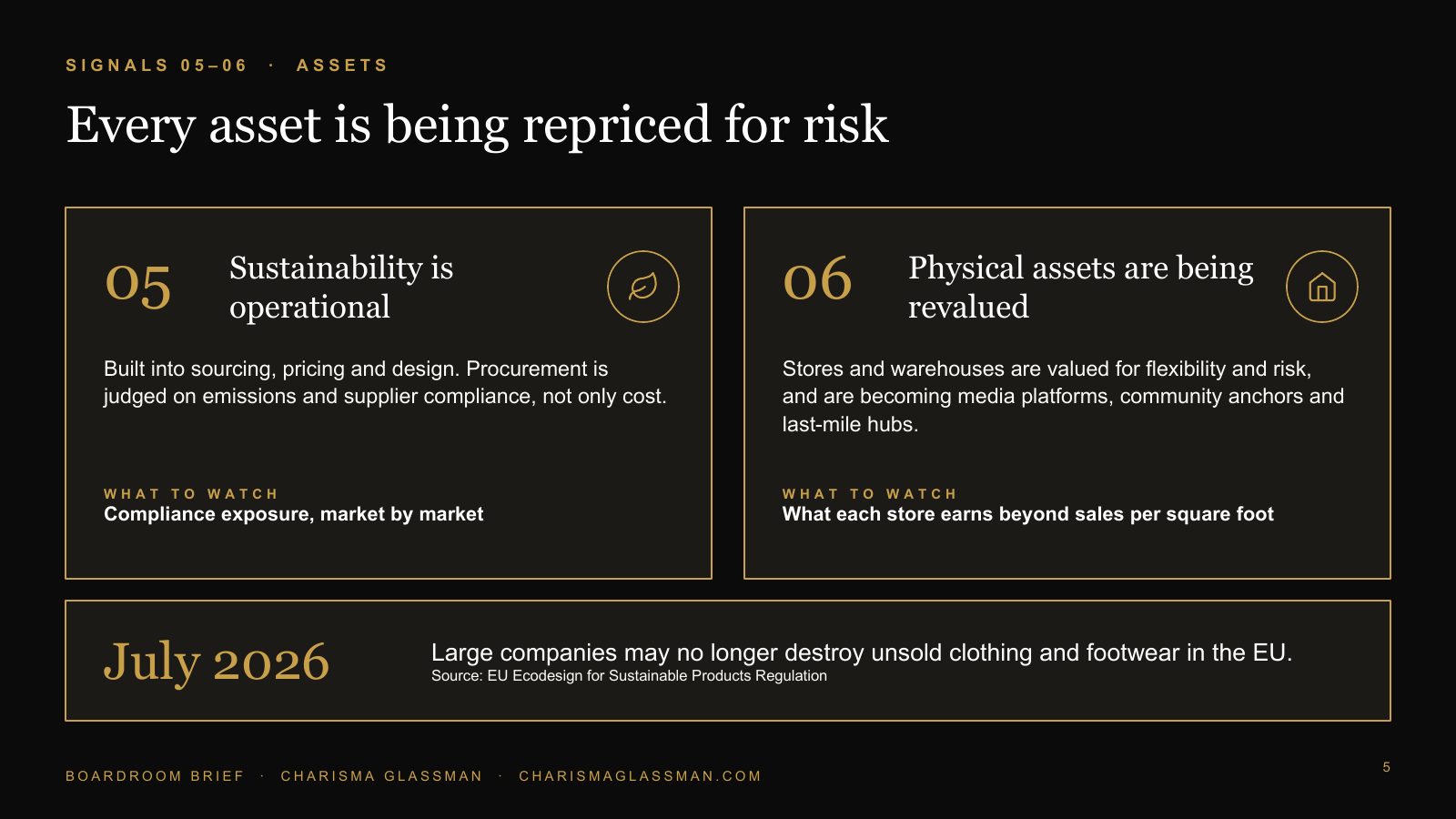
- 05Sustainability is operational
- 06Physical assets are being revalued
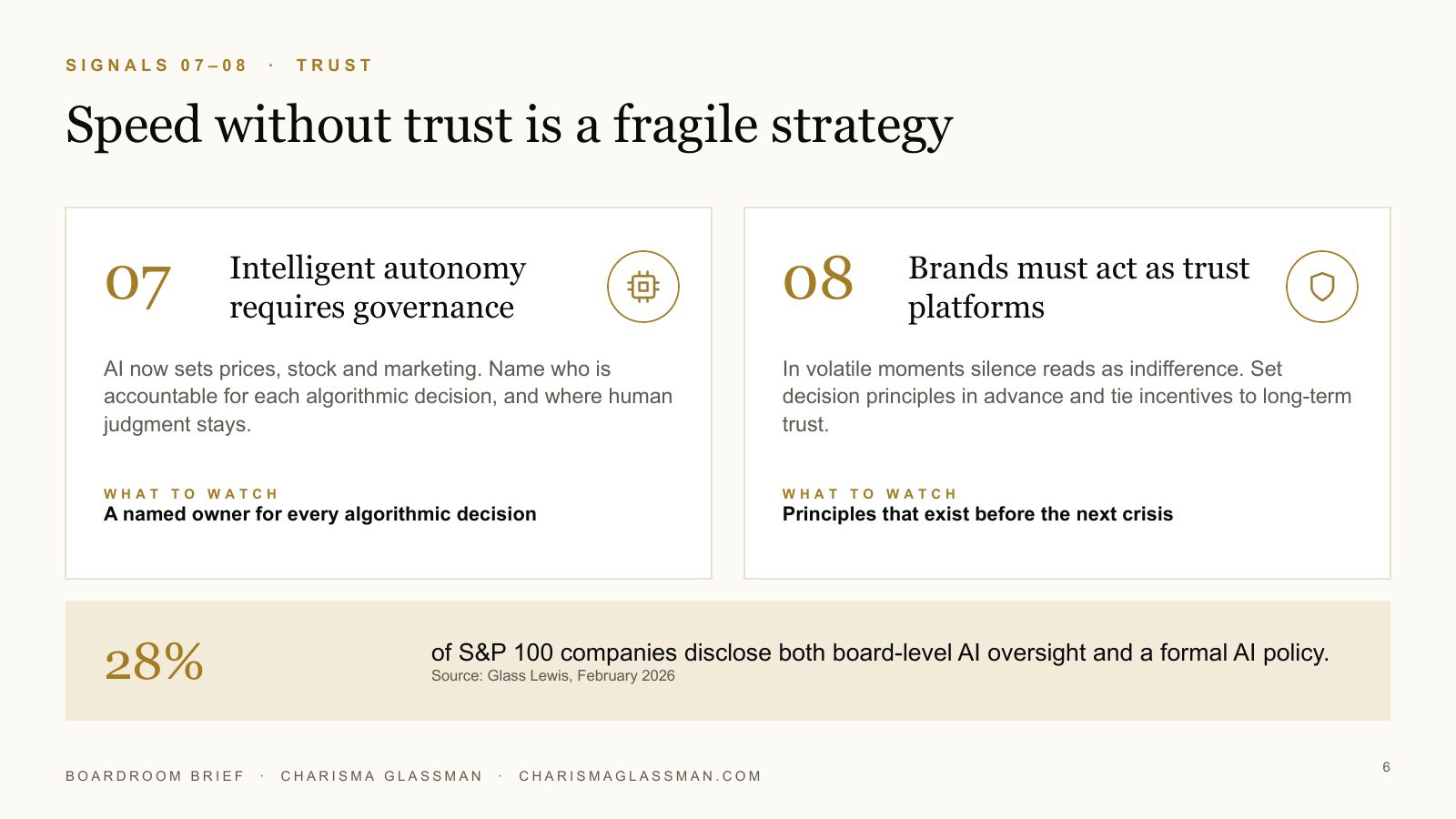
- 07Intelligent autonomy requires governance
- 08Brands must act as trust platforms
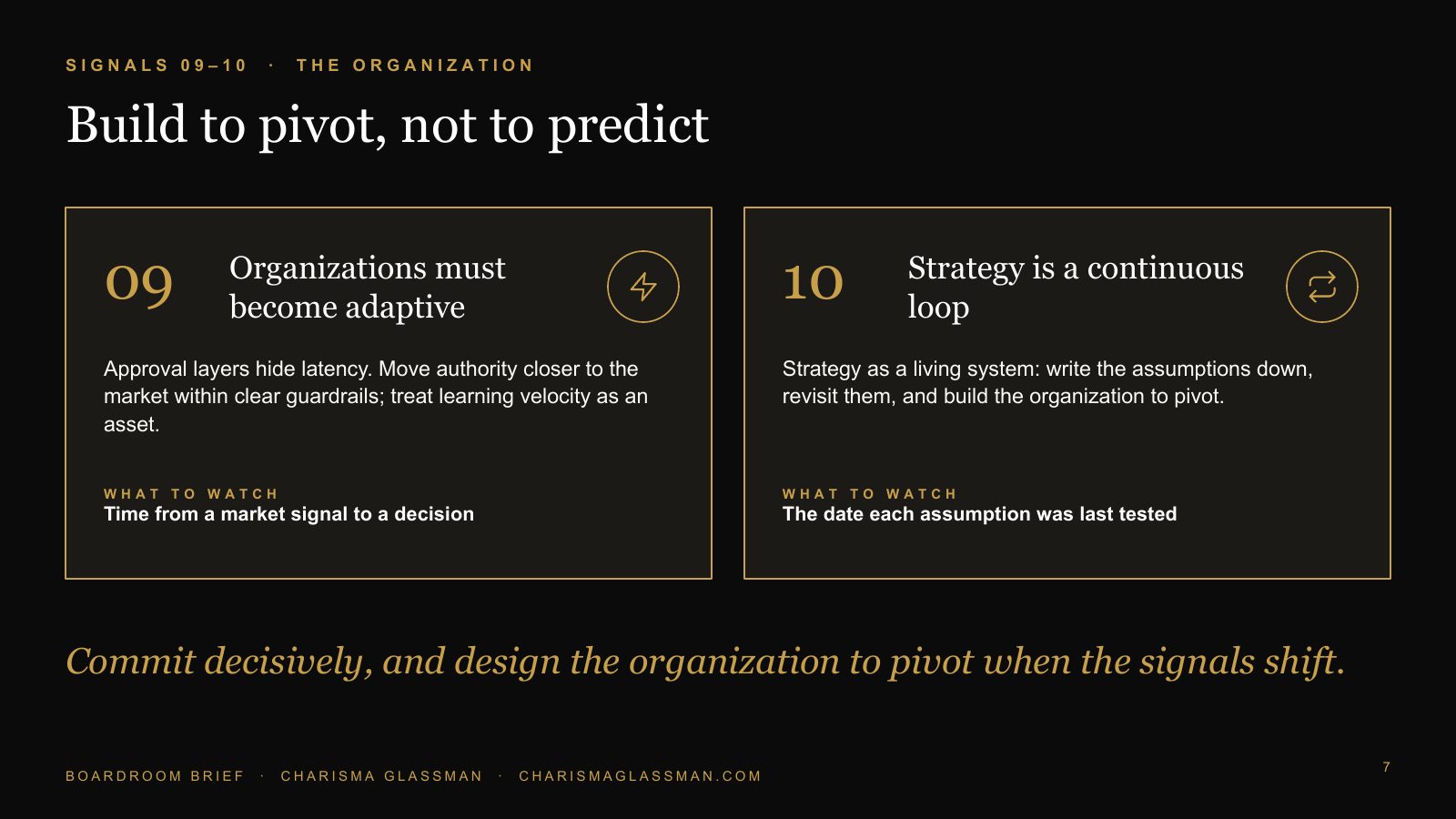
- 09Organizations must become adaptive
- 10Strategy is a continuous loop
- 01
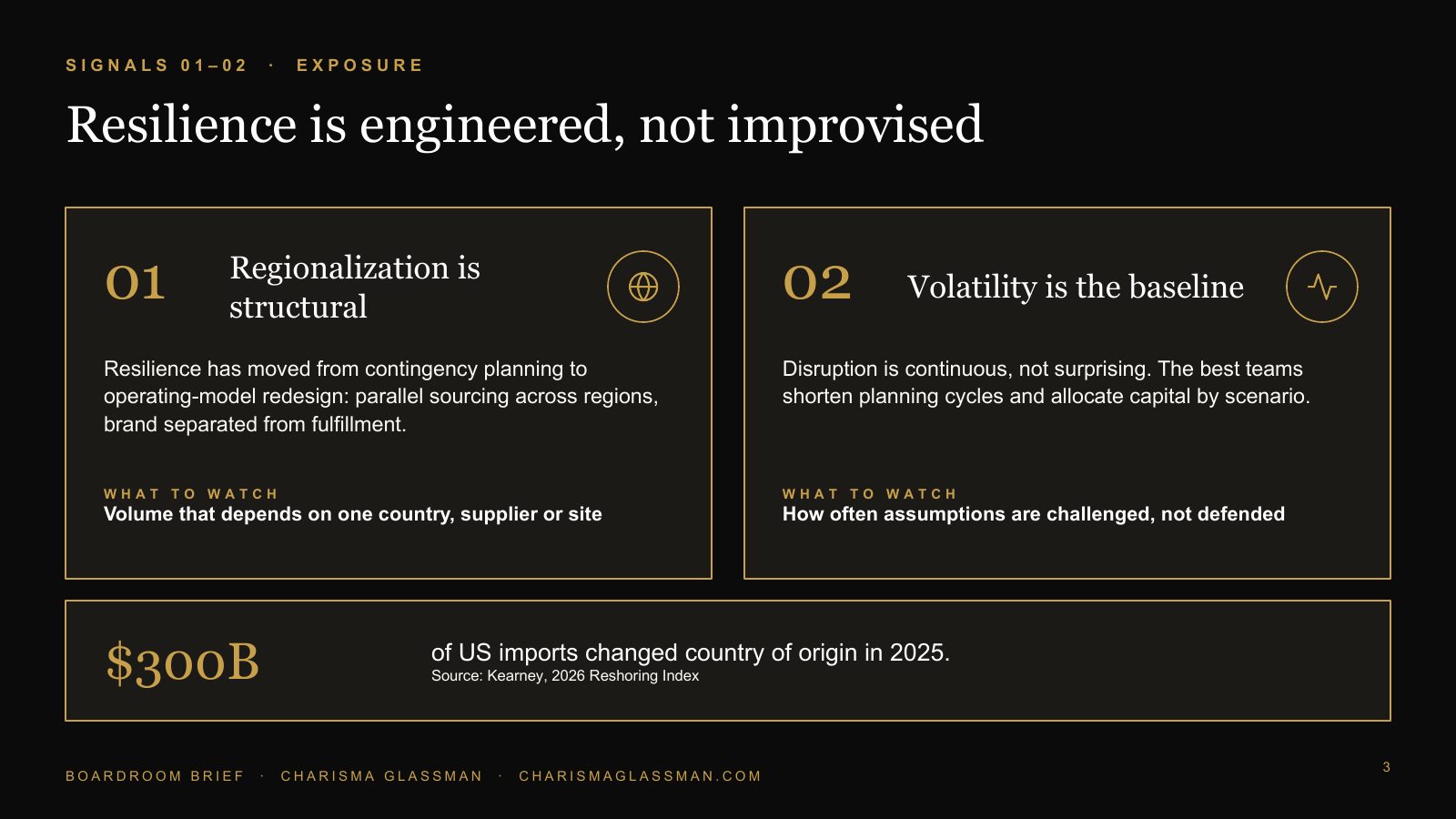
Regionalization is structural
Supply chain resilience has moved from contingency planning to operating model redesign. Leaders are building parallel sourcing and production across regions, and separating brand architecture from fulfillment to avoid concentration risk. Scale still matters; exposure must be managed on purpose.
What to watch The share of volume that depends on a single country, supplier or site.
- 02
Volatility is the baseline
Geopolitical tension, regulatory divergence and climate events are no longer isolated shocks; leaders describe disruption as continuous. The companies navigating it best shorten planning cycles, allocate capital by scenario and run quarterly reviews that challenge assumptions rather than defend them.
What to watch How often strategic assumptions are formally challenged, not just reported.
- 03
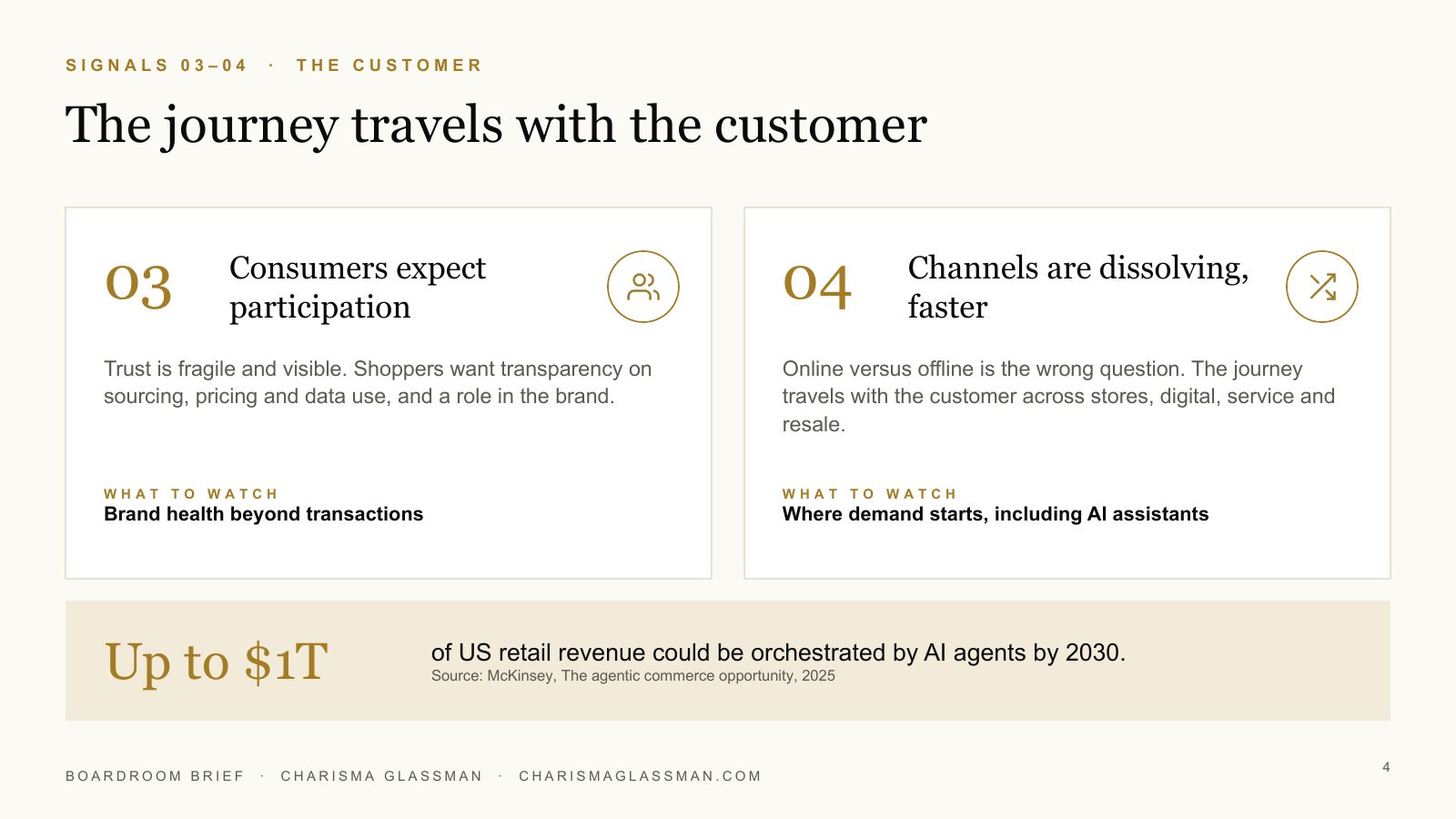
Consumers expect participation
Trust is more fragile and more visible. Brands lose momentum less from weak products than from perceived inconsistency. Shoppers want transparency into sourcing, pricing and data use, so open feedback loops, pilot customization and build recommerce into the core proposition.
What to watch Brand-health measures beyond transactions: trust, transparency and repeat participation.
- 04
Channels are dissolving, faster
Online versus offline is the wrong question. Advanced retailers design journeys that travel with the customer: stores become experience and fulfillment hubs, digital platforms connect to service and resale, and social commerce is accelerating. The question is how seamlessly the ecosystem works together.
What to watch Where demand now starts, including AI assistants and agents, and whether the journey survives each handoff.
- 05
Sustainability is operational
The conversation has moved from reporting and commitments into sourcing, pricing and design decisions. Procurement teams are judged on emissions intensity and supplier compliance as well as savings, and reputational risk travels fast. Sustainability is becoming a condition of market access.
What to watch Unsold-inventory, emissions and supplier-compliance exposure, market by market.
- 06
Physical assets are being revalued
Real estate is a board-level discussion again. Store and warehouse networks are reassessed through a geopolitical and climate-risk lens and valued for flexibility and strategic position, not short-term margin alone. Stores are becoming media platforms, community anchors and last-mile hubs.
What to watch What each store earns from media, services and fulfillment, not just sales per square foot.
- 07
Intelligent autonomy requires governance
AI investment has accelerated in pricing, inventory and marketing, yet board conversations now center on governance and accountability. Durable advantage comes from pairing deployment with capability building and ethical oversight: a clear owner for every algorithmic decision and a defined place for human judgment. Speed without trust is a fragile strategy.
What to watch A named owner for each algorithmic decision, and the board's line of sight to it.
- 08
Brands must act as trust platforms
In volatile moments, silence reads as indifference, and reputations can shift in days. Leaders who navigate this set decision principles in advance, tie executive incentives to long-term trust and communicate openly when trade-offs arise. Trust compounds through consistency.
What to watch Whether decision principles exist before the next crisis, and whether incentives reward trust.
- 09
Organizations must become adaptive
Hierarchies slow response, and decision maps often reveal latency buried in historical approval layers. Organizations move faster by distributing authority closer to the market within clear guardrails, investing in cross-functional capability and treating learning velocity as a competitive asset. Talent strategy is strategy.
What to watch The time from a market signal to a decision, and the approvals in between.
- 10
Strategy is a continuous loop
The strongest teams treat strategy as a living system. They write down their assumptions, revisit them regularly and bring geopolitical monitoring, consumer insight and experimentation into capital allocation. They commit decisively while building the organization to pivot when signals shift.
What to watch A written list of strategic assumptions, and the date each was last tested.
Vision 2030 is not a single forecast. It is the capability to operate with clarity amid complexity and confidence amid uncertainty.
By the numbers
The signals, in figures.
One sourced figure for each signal where the evidence is already measurable.
- $300Bof US imports changed country of origin in 2025.Signal 01 · Regionalization is structuralKearney, 2026 Reshoring Index
- Up to $1Tof US retail revenue could be orchestrated by AI agents by 2030.Signal 04 · Channels are dissolving, fasterMcKinsey, The agentic commerce opportunity
- July 2026Large companies may no longer destroy unsold clothing, accessories and footwear in the EU.Signal 05 · Sustainability is operationalEU Ecodesign for Sustainable Products Regulation
- 83%of US retail sales still happen outside e-commerce (Q2 2026).Signal 06 · Physical assets are being revaluedUS Census Bureau, Quarterly E-Commerce Report
- 28%of S&P 100 companies disclose both board-level AI oversight and a formal AI policy.Signal 07 · Intelligent autonomy requires governanceGlass Lewis, February 2026
The CEO playbook
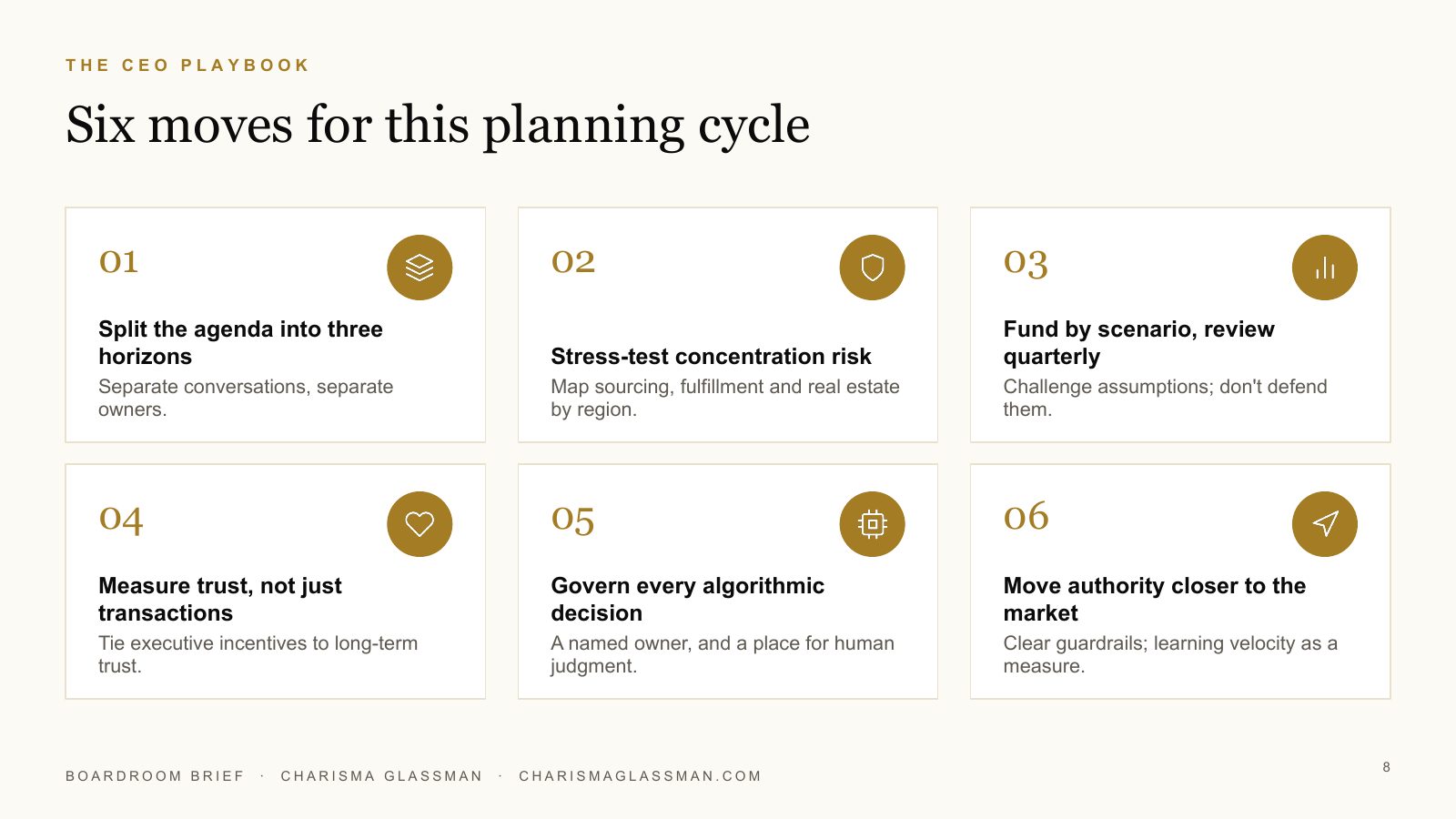
Six moves for this planning cycle.
Each move turns a signal into a decision the board can see.
Split the agenda into three horizons
Run next-year execution, two-to-three-year growth and three-to-five-year positioning as separate conversations, with separate owners.
Stress-test concentration risk
Map sourcing, fulfillment and real-estate exposure by region. Build parallel capacity where one country or supplier dominates.
Fund by scenario, review quarterly
Allocate capital against scenarios, and use quarterly reviews to challenge assumptions, not defend them.
Measure trust, not just transactions
Add transparency, participation and trust measures to the scorecard, and tie executive incentives to them.
Govern every algorithmic decision
Name an accountable owner for each AI decision in pricing, inventory and marketing, and define where human judgment stays.
Move authority closer to the market
Remove legacy approval layers within clear guardrails, and track learning velocity as a competitive measure.
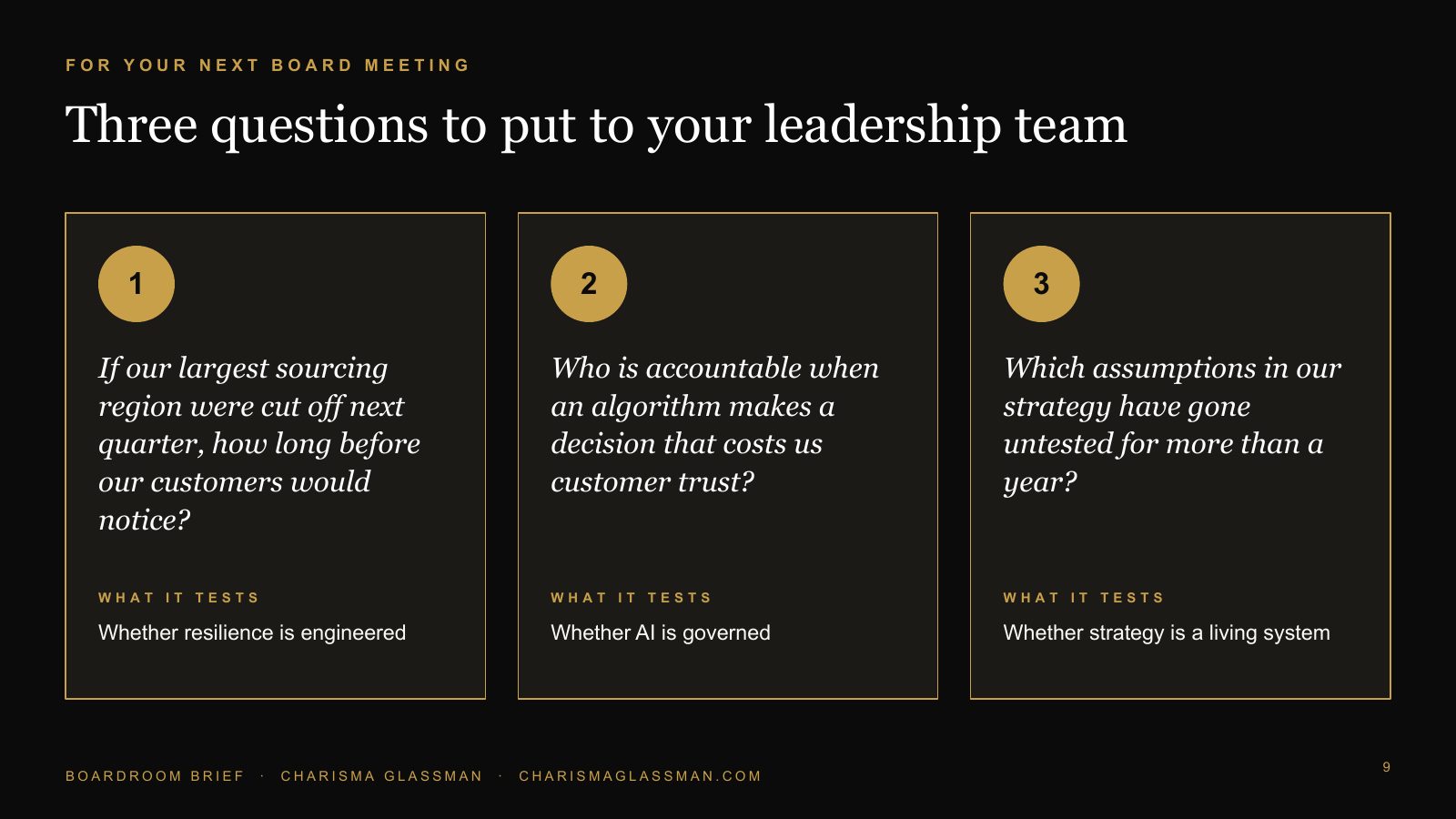
For your next board meeting
Three questions to put to your leadership team.
If our largest sourcing region were cut off next quarter, how long before our customers would notice?
What it tests
Whether resilience is engineered
Who is accountable when an algorithm makes a pricing, inventory or marketing decision that costs us customer trust?
What it tests
Whether AI is governed
Which assumptions in our strategy have gone untested for more than a year?
What it tests
Whether strategy is a living system
Questions leaders are asking
Future of Retail and Consumer 2030, answered.
What will retail look like in 2030?
Retail in 2030 will be shaped less by any single technology than by structural forces already forming. In Charisma Glassman's Vision 2030, ten signals stand out: regionalized supply chains, volatility as the baseline, consumers who expect participation, dissolving channels, operational sustainability, revalued stores and warehouses, governed AI, brands as trust platforms, adaptive organizations, and strategy as a continuous loop.
Will physical stores still exist in 2030?
Yes, with a broader job. About 83% of US retail sales still happen outside e-commerce, according to the US Census Bureau (Q2 2026). Charisma Glassman argues stores are being revalued as experience and fulfillment hubs, retail media platforms, community anchors and last-mile nodes, judged on flexibility and strategic position rather than short-term margin alone.
How will AI change retail by 2030?
AI is moving from pilots into pricing, inventory, marketing and shopping itself: McKinsey estimates AI agents could orchestrate up to $1 trillion of US retail revenue by 2030, and visits to US retail sites from generative AI tools rose 693% in the 2025 holiday season (Adobe). Charisma Glassman's point is that the winners will pair deployment with governance, because speed without trust is a fragile strategy.
What is agentic commerce, and why does it matter for retail strategy?
Agentic commerce is shopping in which AI agents search, compare and buy on a customer's behalf. It speeds up the dissolving of channels: demand can start in an assistant rather than on a site or in a store. For boards, it raises the governance question in Charisma Glassman's seventh signal: who is accountable for decisions an algorithm makes in the company's name.
What are the biggest retail and consumer trends for 2027 and beyond?
For 2027 planning, four of the ten signals have the most near-term pull: volatility as the baseline, channels dissolving as AI assistants become a front door, sustainability rules that change market access (the EU ban on destroying unsold apparel and footwear applies to large companies from July 2026), and board-level AI governance. Regionalization, revalued assets, trust and adaptive organizations compound to 2030.
What is the three horizons framework in retail strategy?
The three horizons framework separates planning by time. Horizon 1 is the next year: protect margin, stabilize operations and deliver commitments. Horizon 2 is two to three years: scale new growth engines and build capabilities. Horizon 3 is three to five years: position for structural forces. Charisma Glassman frames retail and consumer Vision 2030 as a Horizon 3 question.
What should retail and consumer boards do now to prepare for 2030?
Ask three questions this quarter: how long customers would take to notice if the largest sourcing region were cut off; who is accountable when an algorithm costs the company customer trust; and which strategic assumptions have gone untested for a year. Then fund the answers by scenario and revisit them every quarter, the CEO playbook in Charisma Glassman's Vision 2030 brief.
Sources for the figures
- Kearney, 2026 Reshoring Index (April 2026)
- McKinsey, The agentic commerce opportunity (October 2025)
- Adobe Analytics, 2025 holiday shopping season (January 2026)
- European Commission, new EU rules to stop the destruction of unsold clothes and shoes (February 2026)
- US Census Bureau, e-commerce share of total retail sales, Q2 2026 (via FRED)
- Glass Lewis, US AI oversight through three lenses (February 2026)
Read the full column